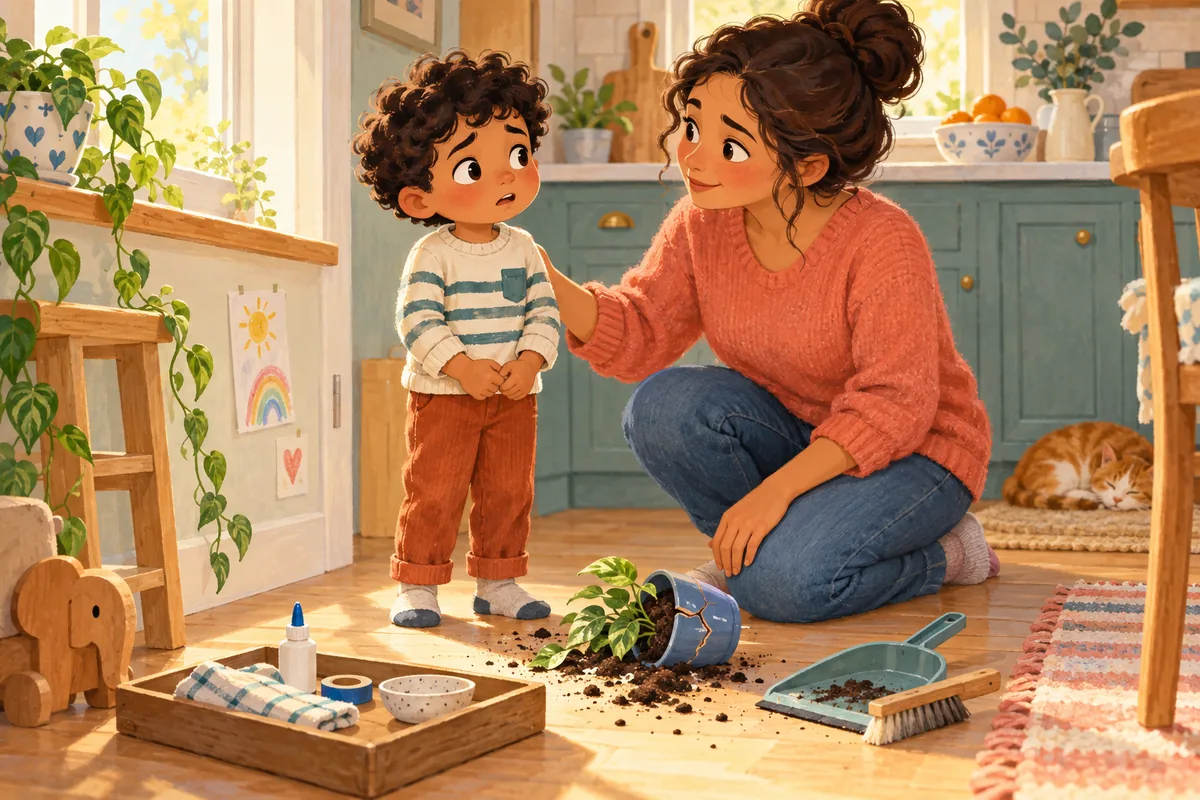
Children sometimes hide a mistake because they fear anger, disappointment or losing something they enjoy. This original story shows that telling the truth can feel difficult and still lead to a useful next step.
Honesty story: Leo and the Cracked Blue Pot
Leo liked helping Mum water the plants. The smallest plant lived in a blue pot on the kitchen windowsill. Its leaves had pale stripes like tiny paintbrush marks.
“Only a little water,” Mum reminded him. “Then put the cup by the sink.”
Leo poured carefully. One leaf had a drop balanced on its tip, and he leaned closer to see it shine. His elbow nudged the pot.
Clunk.
The pot landed on the floor. A crack ran down one side, and dark soil scattered across the tiles.
Leo's heart thumped. Mum was in the hall folding laundry. She had told him not to move the plants by himself. If she saw the mess, she might be upset.
He lifted the pot and turned the crack toward the wall. Then he pushed the loose soil under the cabinet with his sock.
“All finished?” Mum called.
“Yes,” Leo answered quickly. “Nothing happened.”
The words felt like a stone in his mouth.
At snack time, a thin line of water crept from the pot and across the sill. Drip. Drip. Mum followed it to the floor.
“The blue pot is cracked,” she said. “I can see soil under the cabinet too.”
Leo stared at his banana. He wanted to say the cat had jumped up. He wanted the cracked pot to become someone else's mistake.
Mum sat beside him. Her voice stayed steady. “I know the pot fell while you were watering. I want to hear what happened from you.”
Leo's eyes filled. “Will you be cross?”
“I may have a feeling about the mess,” Mum said, “but you are safe to tell me the truth. A mistake is something we can work on.”
Leo took a slow breath. “My elbow bumped it. I hid the crack. I pushed the soil away, and I said nothing happened.”
The stone feeling loosened.
“Thank you for telling me,” Mum said. “The pot is broken, and hiding the soil made the cleanup harder. Now we can repair what we can.”
They carried the plant to the table. Mum found an empty yellow pot. Leo held it steady while she lifted the plant. Together they added fresh soil and pressed it gently around the roots.
Then Leo fetched the dustpan. He swept the spilled soil out from under the cabinet. Some grains escaped twice, but he kept going.
“What should we do with the blue pot?” he asked.
“It cannot hold water now,” Mum said. “But we could use it for pencils after I cover the sharp crack.”
Leo chose a wide teal ribbon. Mum sealed the crack safely, and Leo wrapped the ribbon around the pot. They filled it with crayons and pencils.
“I wish I had told you before the water leaked,” Leo said.
“You can tell sooner next time,” Mum replied. “What words could you use?”
Leo practised: “I made a mistake. The pot fell. Can you help me?”
That evening, Dad noticed the yellow pot on the sill. “Did the plant move house?”
Leo glanced at Mum. His tummy fluttered, but he did not hide.
“I cracked the blue pot by accident,” he said. “Then I hid it because I was worried. Mum helped me clean up, and we made the old pot safe for pencils.”
Dad looked at the ribbon-wrapped pencil pot. “That was a hard truth and a thoughtful repair.”
Leo touched the teal ribbon. The crack was still part of the pot's story. So was telling the truth. So was making things better.
Keep another gentle story close
Baboo Stories offers short stories for parents to read in their own voice when children are working through everyday feelings and choices. Browse the current library and choose what fits your child today.
Baboo Stories is free to download. Some stories are locked, and an optional monthly subscription unlocks all stories.


A parent note about honesty
Children may deny a mistake to avoid a consequence or an adult's disappointment. If you already know what happened, calmly state the facts instead of cornering the child with a question. Avoid labels such as “liar,” leave room for a second answer, and praise the act of telling the truth while still addressing the original problem.
Three gentle questions
- Why did Leo want to hide the cracked pot?
- What helped him tell Mum what really happened?
- What repair did Leo help make after he told the truth?
Use the Truth + Repair card
- Make truth safe: “You are safe to tell me. I want to understand what happened.”
- Name the truth: “I made a mistake. This is what happened.”
- Choose a repair: Clean, replace, apologise or ask for help with one action connected to the mistake.
Practise with a stuffed animal that spills blocks or tears a paper picture. Let your child give the toy a second chance to answer and choose one small repair.
Choose your next shared story
Explore Baboo Stories for more parent-led reading and repeatable family moments. Preview the library before promising your child a particular topic.
Baboo Stories is free to download. Some stories are locked, and an optional monthly subscription unlocks all stories.
Sources and further reading
Questions parents often ask
How can I help my child tell the truth after a mistake?
Stay calm, describe what you know, give your child a chance to answer again, and focus on the next repair step.
Should I call out a lie immediately?
If you already know what happened, avoid a test question. State the facts calmly and invite an honest account.
Does telling the truth remove every consequence?
Honesty does not erase the problem, but it should make repair safer and clearer. Use a related, proportionate response rather than shame.