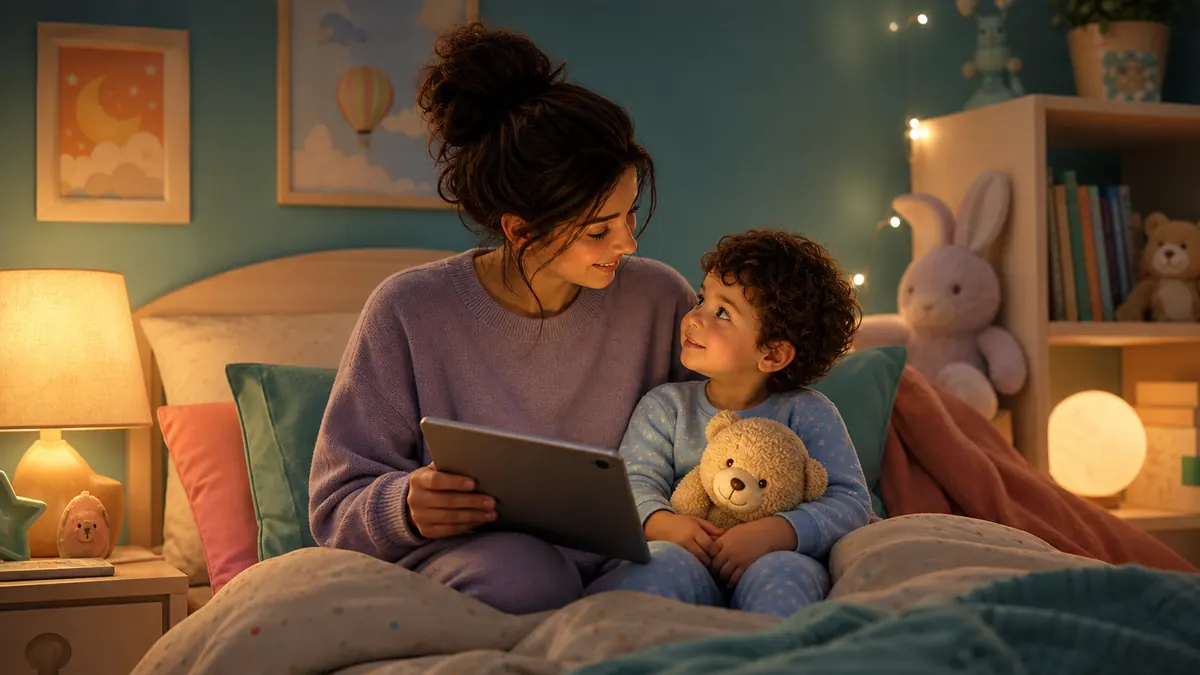
If your toddler wants screen time before bed, you are not alone. Many parents reach the end of the evening with a tired child, a full sink, and very little patience left. A video feels easy because it works quickly in the moment. It gives your child something familiar to watch while you catch your breath.
The problem is not that parents are doing something wrong. The problem is that bedtime videos, cartoons, and endless scrolling can be hard for some toddlers to stop. The goal is not a perfect screen-free home. The goal is a bedtime pattern that feels calmer, more predictable, and easier to repeat.
A parent-led story routine can be a practical middle ground. If screens are only one part of the struggle, our guide to common bedtime mistakes parents make covers other patterns such as rushed reassurance, inconsistent routines, and nighttime fears. With Baboo Stories, the parent holds the device, chooses one gentle story, and reads aloud. The screen becomes a quiet reading tool for you rather than something the child taps, watches, or negotiates with, though it is still a screen.
Why toddlers ask for screens at bedtime
A toddler asking for a phone before bed is not trying to make the evening harder. They are usually asking for something that has become familiar, comforting, or powerful. Screens can become part of the bedtime habit, especially if videos have helped during difficult nights before.
Sometimes the request is really about connection. A toddler may ask for the same cartoon because it has become part of time with you. Sometimes it is a delay tactic. One more video can mean ten more minutes before pajamas, brushing teeth, or lights out. Sometimes it is tiredness. When toddlers are overtired, they often reach for the easiest, brightest thing in the room.
Autoplay adds another pull. Bright, noisy content does not end in a clear way. One clip leads to another, choices keep appearing, and the device keeps offering more. That can make stopping feel much harder than closing a book or finishing one short story.
Why bedtime screen time can make nights harder
Screen time before bed toddlers rely on is not automatically a disaster. Still, many families notice that certain kinds of content make bedtime more difficult. Fast videos, sudden sounds, bright scenes, and constant choices can keep a tired child alert right when the evening needs to slow down.
The American Academy of Pediatrics and HealthyChildren commonly recommend keeping screens out of bedrooms and turning them off at least 60 minutes before bedtime. A recent JAMA Pediatrics randomized clinical trial also found that removing toddler screen time in the hour before bed was feasible for families and showed modest preliminary sleep benefits. Mayo Clinic guidance similarly reminds parents that passive screen time should not replace reading, play, problem-solving, or parent-child interaction.
Those points are helpful, but they do not need to become another reason to feel guilty. The practical takeaway is simple: bedtime usually works best with predictability and lower stimulation. When the evening has a clear beginning, middle, and end, toddlers have fewer reasons to bargain for more.
The goal is not a perfect screen-free home
Most parents are not trying to win a perfect bedtime award. They are trying to get through real evenings with real children. Some nights are messy. Some nights a video happens. That does not erase all the calm moments you are building.
A realistic goal is to reduce the most stimulating screen habits near sleep. That might mean moving cartoons earlier in the evening, ending autoplay before pajamas, or replacing child-led phone time with one parent-led story. Small changes are easier to repeat than a rule that feels impossible.
If you already use a simple toddler bedtime routine, this can fit inside it. The story does not need to be long. It only needs to signal that the busy part of the day is ending.
Screen-free vs screen-light: what is realistic?
Screen-free means no device during bedtime. For some families, that is the right choice. A printed book, a cuddle, and a familiar goodnight phrase can be beautifully simple.
Screen-light means something different. The device is present, but it is not handed to the child. The parent uses it as a quiet story tool. Brightness can be lowered, notifications can be silenced, and the parent stays in charge of the pace. If this is the exact question on your mind, our guide to reading from a phone without passive screen time explains the difference in more detail.
Baboo Stories is designed for this screen-light approach. It is a bedtime story app for toddlers that supports parent-led reading, not child-led scrolling. The focus stays on your voice, your closeness, and the story you share together.
Because guidance suggests avoiding screens in the hour before bed, the lowest-screen option for the very last step is a printed book or a story told from memory. If you use a phone story, try reading it earlier in the wind-down, keep it short, and put the phone away before lights out.
A calmer replacement routine for bedtime screen time
If you are wondering what to do instead of screen time before bed, start with a routine that is almost too simple. The more tired your child is, the fewer choices they need.
- Dim the lights. Make the room feel different from playtime.
- Put the device in the parent's hand. Say clearly that you will choose and read.
- Choose one gentle story. Keep the choice small so bedtime does not become a menu.
- Read aloud slowly. Let your voice become softer as the story goes on.
- Ask one soft question. Try something simple from these calming bedtime prompts.
- Repeat the same goodnight phrase. For example, “Story is done, cuddle is done, now we rest.”
On busy nights, choose a shorter version. A 5-minute bedtime story can be enough when the rhythm is consistent.
No story ready? A familiar rhyme works too. Try a slow one such as Row, Row, Row Your Boat from our 15 nursery rhymes for 2-year-olds.
What to say when your toddler asks for one more video
The words do not need to be clever. They need to be short, kind, and repeatable. Try one script and use it the same way for several nights:
- “Videos are finished for tonight. Now we choose one story together.”
- “The screen is resting. I will read to you.”
- “One story, one cuddle, then sleep.”
- “You really wanted another video. Tonight the video is done, and my voice is here.”
- “We can watch another time. Bedtime is for our story.”
Expect some protest at first, especially if bedtime videos have been the usual pattern. A calm boundary does not mean your toddler will love the change immediately. It means you are making the new ending clear and predictable.
How Baboo Stories helps
Baboo Stories can help families who want a bedtime story app instead of YouTube, cartoons, or child-led phone use at night. The app is built around short, gentle stories that a parent can read aloud. It is meant to support bedtime bonding, not replace it.
Because the parent leads, the story can slow down when your child seems sleepy. You can pause, cuddle, whisper a line, or skip a question if the room is already calm. There is no need to frame the moment as noisy autoplay or endless choice. The story has an ending, and you can make that ending feel warm.
If you want a calmer parent-led option, you can find the Baboo Stories app here. Use it as a screen-light story tool: parent holds the device, parent reads, child listens, cuddles, and settles into the routine.
A 7-night screen-light reset
A one-week reset gives your toddler time to learn the new pattern without asking you to change everything overnight.
- Night 1: Move videos earlier and explain the new bedtime plan before pajamas.
- Night 2: Let your toddler choose between two gentle stories, then close the choice.
- Night 3: Use the same script when they ask for one more video.
- Night 4: Add one soft question after the story, then repeat your goodnight phrase.
- Night 5: Lower the brightness and keep the device in your hand the whole time.
- Night 6: Shorten the routine if needed, but keep the order the same.
- Night 7: Notice what felt easier and keep the smallest version that works.
This reset does not guarantee better sleep. It simply gives your family a calmer script, a calmer story, and a clearer ending than autoplay can offer.
FAQ
Is screen time before bed bad for toddlers?
Not every screen moment is the same, and parents do not need to feel guilty. The concern is that bright, noisy, fast content can be stimulating for some toddlers and hard to stop. A calmer routine can reduce the most activating parts of bedtime screen use.
How long before bed should toddlers stop screen time?
HealthyChildren guidance from the American Academy of Pediatrics commonly recommends turning screens off at least 60 minutes before bedtime and keeping screens out of bedrooms. If that feels too hard right now, start by replacing the last video of the night with a quiet parent-led story.
What can I use instead of YouTube at bedtime?
Use one short story, one cuddle, and one repeated goodnight phrase. A calm story app can help if the parent holds the device and reads aloud, so the screen supports connection instead of inviting more watching.
Are bedtime story apps okay for toddlers?
They can be, when they are used as parent-led reading tools. A screen-light story app is different from handing the device to a toddler for solo scrolling, tapping, or autoplay videos.
How do I stop my toddler asking for videos before sleep?
Keep the boundary warm and repeatable. Say, “Videos are finished for tonight. Now we choose one story together.” Then offer the same calm replacement each night so the new routine becomes familiar.
Is reading from a phone still screen time?
Yes. The adult still uses a screen, even though the child is listening rather than watching. Parent-led reading is a different experience from videos, but it is not screen-free.
Sources and further reading
- American Academy of Pediatrics: Family Media Plan
- JAMA Pediatrics trial on toddler screen use before bed
- Mayo Clinic: Screen time and children
- NHS: Sleep and young children
Find your next read-aloud story
Choose a short story and read it aloud in your own voice. Baboo Stories is free to download; some stories are locked, and an optional monthly subscription unlocks all stories.