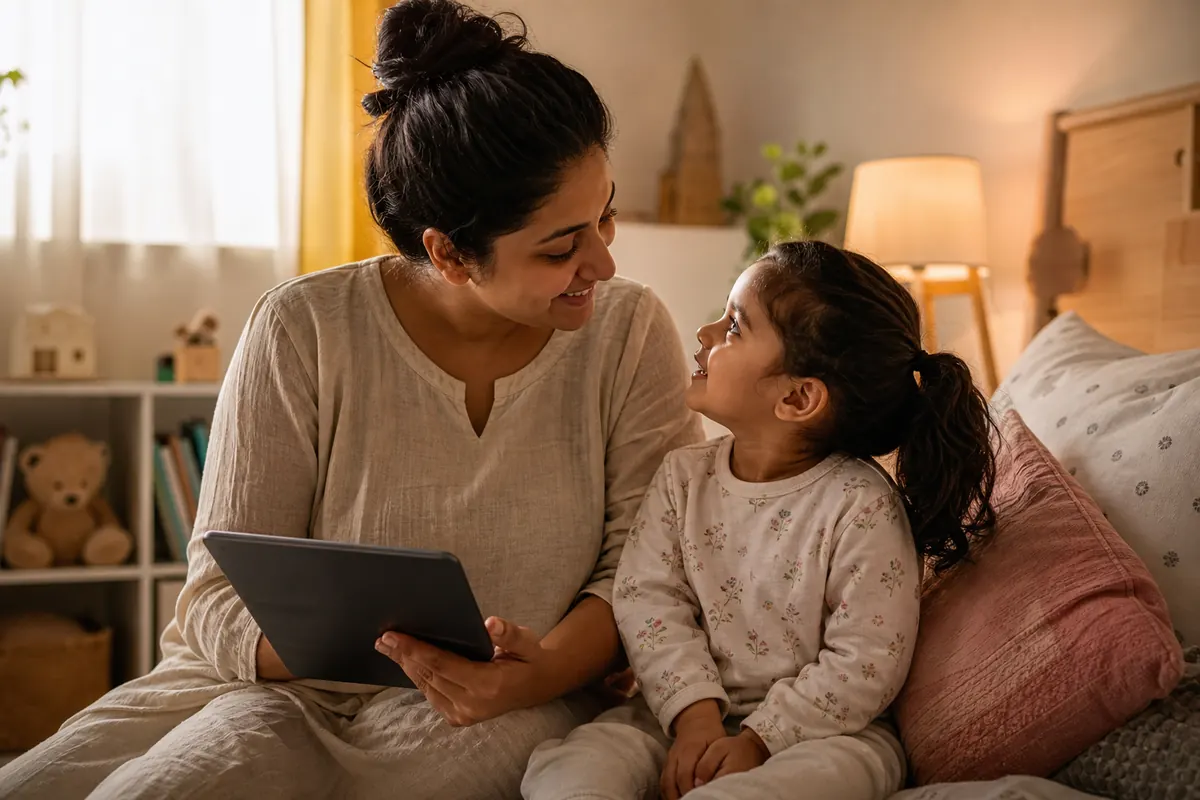
Parents are right to ask: are AI story apps safe for kids? A bedtime story is not just content. It can include a child's name, interests, fears, routines, voice, photos, or reading habits. That makes safety about more than whether a story sounds cute.
A good AI story app should help families create gentle, age-friendly stories while protecting children's privacy and keeping parents in control. This checklist explains what to look for before using AI stories with toddlers, preschoolers, or early readers.
The short answer
Safety depends on the particular app, its content and data practices, and how it is used. Check the controls and preview generated stories; these checks cannot guarantee that every output will be suitable.
1. Check what child data the app collects
Children's story apps may ask for details that make stories feel personal: name, age, favorite animals, interests, family roles, or emotional themes. Some details are useful. Too many details can be a privacy concern.
The Federal Trade Commission's COPPA guidance focuses on protecting personal information from children under 13. Parents should look for clear answers to basic questions: What data is collected? Why is it needed? Is it shared? Can it be deleted? Is parental consent required where appropriate?
2. Prefer minimal personalization
Personalization should make a story more meaningful, not more invasive. A safe story app can personalize with broad choices like "space adventure," "gentle bedtime," or "brave bunny" without needing sensitive information.
Swipe or scroll horizontally to compare all columns.
| Lower-risk personalization | Higher-risk personalization |
|---|---|
| Age range | Exact birth date |
| Favorite theme | Home address or school name |
| Story mood | Detailed emotional profile |
| Parent-selected character name | Child voice, photo, or biometric data |
3. Look for parent controls
Parents should be able to choose story themes, age range, length, and bedtime tone. They should also be able to stop a story, skip a theme, report a problem, and manage saved data.
Strong parent controls matter because AI-generated content can vary. Even a well-designed system may occasionally create a story that is too exciting, too complex, or emotionally mismatched for bedtime.
4. Ask how content is filtered
AI story apps should have safeguards for violence, fear, adult themes, stereotypes, unsafe instructions, and inappropriate language. The app should be clear that it is designed for children, not a general chatbot with a children's wrapper.
UNICEF's AI guidance for children emphasizes child-centered design, privacy, fairness, transparency, and safety. For parents, that means a story app should do more than generate text. It should actively shape the experience around children's needs.
Keep story time parent-led
Baboo Stories is designed around gentle stories and parent prompts, so technology supports the adult's voice instead of replacing it.


5. Avoid ad-driven story apps for young children
Ads, recommendation feeds, and cross-promotions can work against a calm bedtime routine. They may also create privacy and attention concerns. For young children, an ad-free story environment is much easier for parents to trust.
If an app is free, look carefully at the business model. Does it rely on ads? Does it share data with partners? Does it push children toward extra content? A bedtime story should not become a marketing funnel.
6. Use AI stories with an adult nearby
Young children learn most from stories when an adult is present to explain, pause, answer, and connect the story to real life. NAEYC's guidance on technology for infants and toddlers stresses adult mediation and interaction rather than passive use.
With AI stories, parent presence also adds safety. You can notice if a story is too scary, correct a confusing idea, or turn a generated sentence into a warm conversation.
7. Check whether stories are saved
Some families love saving personalized stories. Others prefer that stories disappear after reading. Both can be fine if the app gives parents a choice.
Look for simple deletion controls. Parents should be able to delete child profiles, story history, and personalized content without a confusing process.
8. Make sure bedtime stories stay calm
Safety is not only privacy. It is also emotional fit. A story app that generates exciting cliffhangers, spooky scenes, or problem loops may be fun in the afternoon but unhelpful at bedtime.
For bedtime, choose stories with gentle stakes, predictable endings, soothing language, and room for a short parent-child prompt. If you are thinking about tone, read our guide on scary stories and toddlers.
AI story app safety checklist
Swipe or scroll horizontally to compare all columns.
| Question | Why it matters |
|---|---|
| Does the app clearly explain its privacy policy? | Parents need to understand data collection and sharing. |
| Can parents delete child data? | Families should control stored profiles and story history. |
| Are stories filtered for age and safety? | Generated content needs child-specific safeguards. |
| Is the app ad-free for children? | Ads can undermine trust, focus, and bedtime calm. |
| Can parents control story length and tone? | Bedtime needs predictable, gentle pacing. |
| Does the app support shared reading? | Parent-led use improves connection and safety. |
How Baboo thinks about safe story technology
Baboo Stories is best understood as an alternative to a traditional storybook, not as a replacement for parents. The app gives families a bunch of stories to choose from, but the heart of the experience is still simple: a parent and child sharing a story together.
Many Baboo stories are inspired by tales that have been loved for generations, including stories that have been around for hundreds of years. We rewrite and shape them for today's young children so they feel calmer, softer, and more age appropriate. The goal is to keep the magic of classic storytelling while making the tone gentler for bedtime and family reading.
We also use feedback and guidance from educators to make stories better for children: clearer language, kinder themes, simpler emotional moments, and prompts that help parents talk with their child. A good story app should support the adult's voice, not push children into endless content or ask families for unnecessary personal information.
For different reading experiences, compare parent reading, narration and other story options.
Common questions parents ask
Are AI bedtime stories okay for toddlers?
Do not assume an AI app is suitable for toddlers because it offers child-themed stories. Preview content, check data practices and stay involved; safeguards do not guarantee every output.
Should I enter my child's real name?
Use the least personal information needed. A nickname or broad character choice is usually enough for a personalized story.
What is the biggest risk with AI story apps?
The biggest risks are unclear data collection, weak content filtering, ad-driven design, and children using generated content without an adult involved.
Can AI stories help children learn?
Yes, especially when parents use them as a starting point for reading aloud, vocabulary talk, feelings discussion, and imaginative play.
Sources and further reading
- Federal Trade Commission: Children's Privacy and COPPA
- UNICEF: Policy Guidance on AI for Children
- NIST: AI Risk Management Framework
- NAEYC: Technology and Young Children, Infants and Toddlers
Choose story technology with care
Join Baboo Stories Free Stories & Updates for gentle, parent-led story moments designed around connection, imagination, and calm.
For stories you can read in your own voice, explore Baboo Stories. The app is free to download; an optional monthly subscription unlocks all stories.