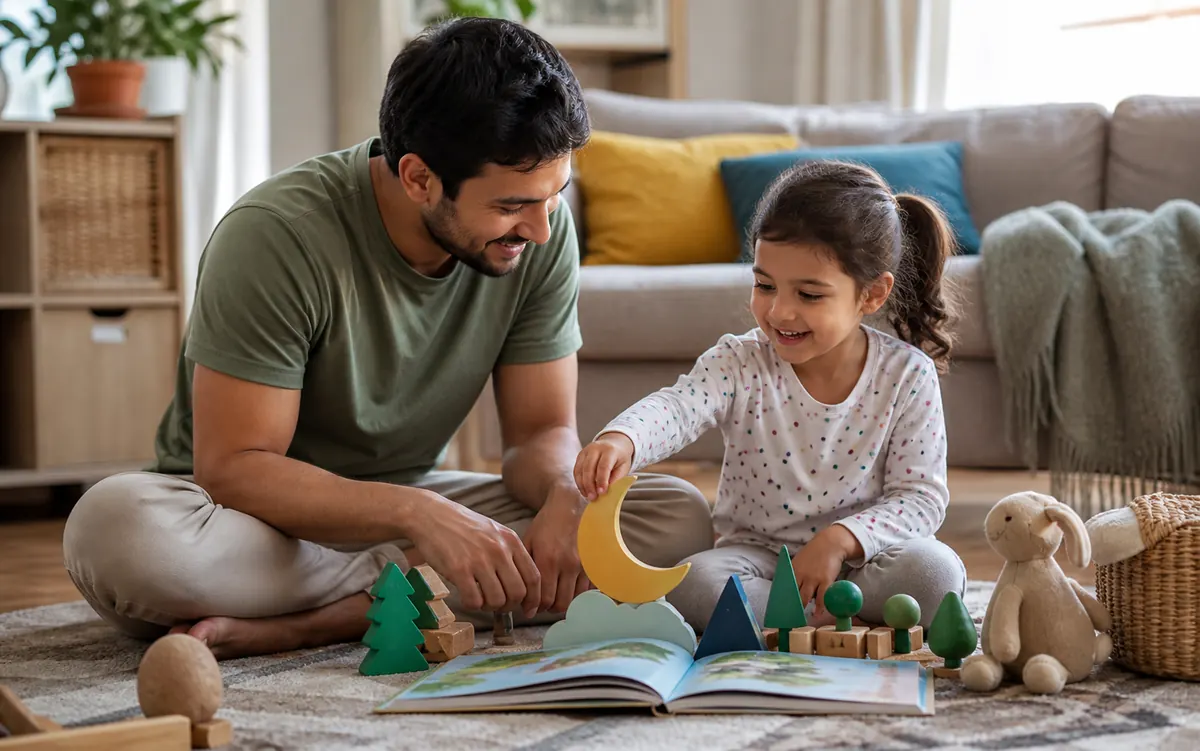
Indoor movement does not need a playroom, special equipment or a miniature obstacle course. A toddler can reach, turn, march, carry or roll something safely within one clear patch of floor.
This page focuses on active play for small indoor spaces. For a broader mix of pretend, creative and active ideas, visit our screen-free toddler activities hub. For a slower part of the day, choose from these quiet time activities for toddlers.
Pick an indoor movement game in 30 seconds
Swipe or scroll horizontally to compare all columns.
| Activity | Space | Noise | Setup | Adult role |
|---|---|---|---|---|
| Mirror moves | One spot | Quiet | None | Move together |
| High-and-low reaches | One spot | Quiet | None | Call directions |
| Paper footprints | Short path | Quiet | 3 minutes | Place and supervise |
| Soft-toy delivery | Short path | Low | 1 minute | Name destinations |
| Scarf reach and drop | One spot | Quiet | None | Stay beside child |
| Sock basket moves | Small room | Low | 2 minutes | Sort together |
| Roll to a target | Floor lane | Quiet | 1 minute | Roll back |
| Towel-basket push | Clear floor | Low | 2 minutes | Guide closely |
| Move like weather | One spot | Flexible | None | Narrate |
| Quiet marching | One spot | Low | None | Set the beat |
| One action rhyme | One spot | Flexible | None | Lead gently |
| Character movement | Small room | Flexible | None | Join the story |
| Follow my shadow | One spot | Quiet | None | Take turns |
| Walking stop-and-go | Short path | Low | None | Give signals |
| Tidy-up bends | Small room | Low | 1 minute | Move together |
Before you start: make one safe movement zone
Clear cords, hot drinks, sharp-edged objects and small items from the floor. Move play away from stairs, windows, glass and furniture that could tip. Choose walking, reaching and floor-level movement instead of jumping from furniture or climbing stacked cushions.
The World Health Organization encourages varied physical activity spread through the day for children under five. That does not mean every play session needs a target or timer. The American Academy of Pediatrics and Head Start also offer everyday active-play ideas built around simple movement and adult involvement.
15 indoor movement activities for toddlers
Adapt each idea to your child and your home. Stay close, demonstrate once and let watching count as participation.
1. Copy slow mirror moves
How to start: Face your toddler and move one body part slowly: open your arms, turn your palms or lean gently to one side. Invite them to copy, then copy their movement.
Quieter option: Keep both feet planted and use only hands, shoulders and facial expressions.
2. Reach high, middle and low
How to start: Call “high,” “middle” or “low” and move your hands to that level. Add “wide” and “small” when the first three feel familiar.
Keep it safe: Reach only as far as your child can comfortably control. There is no need to balance on toes or stand on an object.
3. Follow paper footprints
How to start: Cut or draw four large paper footprints and place them flat in a short line on a non-slip surface. Walk beside the prints, step between them or turn each print in a new direction.
Check first: Secure the paper so it cannot slide, and remove it when play ends.
4. Make a soft-toy delivery
How to start: Put two soft toys in one place and choose a nearby destination. Carry one bear to the chair, then one rabbit to the rug. Let your toddler choose how the next toy travels.
Small-space version: Deliver between two baskets only a few steps apart.
5. Reach, wave and drop a scarf
How to start: Hold a lightweight play scarf or small cloth at shoulder height. Reach up, wave it slowly and drop it into a basket. Take turns.
Safety: Stay beside your child, keep fabric away from the face and neck, and put it away immediately after play.
6. Move socks between baskets
How to start: Place a few clean rolled socks in one basket and an empty basket a short distance away. Carry them one at a time, then sort by colour or owner.
Add a choice: Ask whether the next pair should travel with big steps, tiny steps or sideways steps.
7. Roll a soft ball to a target
How to start: Sit on the floor and roll a soft, age-appropriate ball toward an empty box or between two large objects. Your toddler can roll it back or move the target closer.
Indoor rule: Roll rather than throw, and keep breakables and stairs outside the play area.
8. Push a light towel basket
How to start: Put two or three towels in a stable, lightweight laundry basket. On a clear, suitable floor, let your toddler push it slowly toward you.
Supervise closely: Stop if the basket catches, tips or becomes a climbing object. Keep the route away from stairs and unstable furniture.
9. Move like slow weather
How to start: Sway like a breeze, crouch like a small cloud, open your arms like sunshine or tap fingers softly like rain. Let your toddler choose the next weather.
Keep it neighbour-friendly: Make the storm a finger wiggle instead of stamping or running.
10. March to quiet beats
How to start: Tap a slow beat on your knees while your toddler marches in place. Pause, change the speed or invite them to control the beat.
Low-noise version: Lift heels gently without stamping, or march while seated.
11. Add movement to one familiar rhyme
How to start: Choose one short verse and pair it with two actions, such as rowing arms and swaying. Repeat rather than adding more instructions.
Find a starting point: Use one of these nursery rhymes with easy movements. Your toddler can watch, copy one action or simply listen.
12. Move like one story character
How to start: Name one familiar character and choose one movement: tiptoe like a mouse, stretch like a waking bear or turn slowly like a curious owl.
Keep it focused: One character and one scene are enough. For a fuller pretend-play activity, try story role play for kids.
13. Follow my shadow
How to start: Stand side by side and make a slow shape with your body. Your toddler follows as your “shadow,” then you follow them.
No perfect copying: If their version looks completely different, follow it anyway.
14. Play walking stop-and-go
How to start: In a clear short lane, say “walk” and move together. Say “stop” and become still. Swap roles when your toddler wants to lead.
Indoor boundary: Keep it to walking, not running. Use a hand signal if you need a quieter game.
15. Turn tidy-up into bend-and-place
How to start: Put three large toys on the floor beside a low basket. Bend to pick up one toy, stand and place it in the basket. Move together without racing.
Stop at three: The activity can end before the whole room is tidy. Avoid heavy toys or asking a child to lift above shoulder height.
What if your toddler does not join?
A child may watch, leave or want a different kind of play. Keep the invitation light:
- Demonstrate once. Start the movement without repeating instructions.
- Offer two choices. Ask “rolling or marching?” rather than presenting the whole list.
- Shrink the action. March while seated or move one toy instead of crossing the room.
- Let watching count. Your child does not need to copy you.
- Pause without pressure. Try again later if the answer is still no.
Indoor movement safety
- Keep play floor-level. Skip sofa and bed jumping, stacked-cushion climbing, stairs and indoor trampolines.
- Clear the route. Remove cords, hot drinks, breakables, sharp corners and small objects before movement begins.
- Check furniture. Keep play away from unstable televisions, dressers and furniture that could tip if pushed or climbed.
- Use soft, age-appropriate materials. Choose soft balls and large objects; avoid balloons, hard projectiles and choking hazards.
- Stay close. Match the activity to your child's current balance, coordination and tendency to climb, mouth or throw materials.
The U.S. Consumer Product Safety Commission recommends childproofing the home and anchoring furniture and televisions that can tip. The American Academy of Pediatrics advises against trampoline use for children younger than six. This guide therefore keeps every activity on a stable floor without climbing or bouncing equipment.
Questions parents often ask
What are good indoor movement activities for toddlers?
Good small-space options include mirror moves, high-and-low reaches, paper footprints, soft-toy delivery, scarf drops, sock sorting, ball rolling, weather movements, marching, action rhymes, character walks and walking versions of stop-and-go games.
How can a toddler move indoors without much space?
Choose movements that stay on one clear patch of floor, such as reaching, marching in place, copying shapes, rolling a soft ball or moving one toy at a time. Clear hazards and keep the activity floor-level.
What are quiet indoor movement games for an apartment?
Try slow mirror moves, reaching high and low, silent marching, scarf drops, paper-footprint steps, rolling a soft ball or moving like slow weather. Use a rug where suitable and choose walking instead of running or jumping.
How long should indoor movement play last?
There is no required length for one game. Offer one activity, repeat it while your toddler is interested and stop or switch when it is no longer working. Movement can happen in many short moments across the day.
What if my toddler does not want to join a movement activity?
Make the invitation smaller. Demonstrate one movement, offer a choice between two games or let your child watch. If they still decline, pause and try another time without turning the activity into a test.
Sources and further reading
- World Health Organization: Guidelines on Physical Activity, Sedentary Behaviour and Sleep for Children Under 5 Years of Age.
- CDC: Positive Parenting Tips for Toddlers Ages 1 to 2.
- American Academy of Pediatrics: The Active Toddler.
- Head Start: Active Play Every Day at Home.
- U.S. Consumer Product Safety Commission: Childproofing Your Home.
- American Academy of Pediatrics: Trampoline Safety.
Turn one story moment into movement
Baboo Stories gives parents story text to read aloud from a phone. Phone-based reading is not screen-free. You can read one short scene together, put the phone away, then move like one character on a clear patch of floor.
The app is free to download. Some stories are locked, and an optional monthly subscription unlocks all stories.