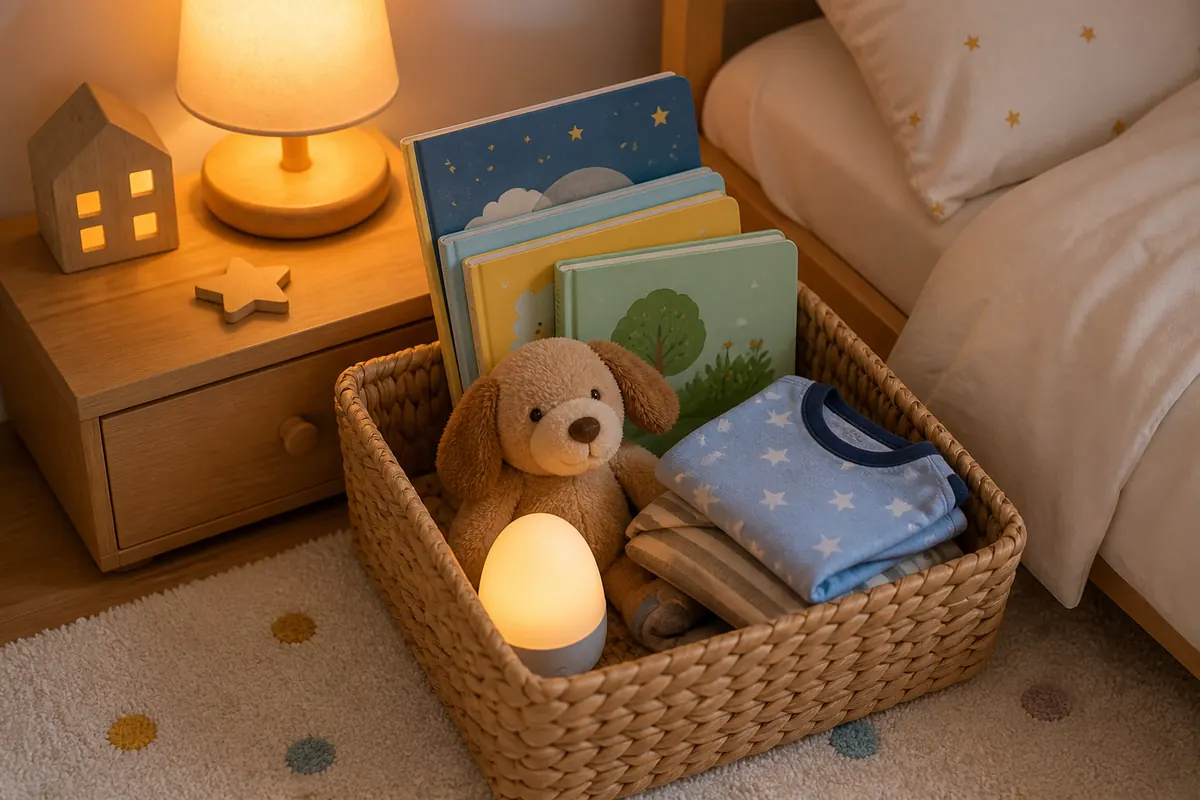
Quiet time can be a gentle change of pace after lunch, between outings or while the household settles. It is not bedtime training, and it does not have to produce silence. Start with one familiar activity, lower the number of choices and see what your toddler does with it.
This guide focuses on calm, low-mess ideas. For higher-energy play and a wider activity menu, use our hub of screen-free activities for toddlers at home.
Pick a quiet activity in 30 seconds
Swipe or scroll horizontally to compare all columns.
| Activity | Setup | Mess | Adult role |
|---|---|---|---|
| Board-book basket | None | None | Read or stay nearby |
| Picture walk | None | None | Look and talk together |
| Large-piece puzzle | 1 minute | None | Help when invited |
| Small block neighbourhood | 1 minute | Low | Begin one structure |
| Cup nesting | None | Low | Model once |
| Large-crayon drawing | 2 minutes | Low | Draw alongside |
| Water painting | 3 minutes | Low | Supervise closely |
| Washcloth sort and fold | 1 minute | Low | Sort together |
| Soft-toy picnic | 2 minutes | Low | Join the pretend play |
| Scarf hide-and-find | None | Low | Hide and reveal |
| Slow rhyme and actions | None | None | Lead gently |
| Three-item story basket | 3 minutes | Low | Start the story |
Quiet does not mean silent or alone
A toddler may hum while drawing, talk to a toy or ask you to read the same page again. That can still be a quieter activity. Quiet time can also be shared: you might sit on the floor, turn puzzle pieces, read aloud or simply stay within reach.
ZERO TO THREE includes books, stories and drawing among quiet play ideas for children aged 24 to 36 months. Its at-home guide also suggests familiar options such as reading, colouring, puzzles, blocks, sorting and pretend play. The useful pattern is simple materials and a responsive adult, not a promise that every toddler will play alone.
12 low-mess quiet time activities
Adapt each idea to your child's stage. Use fewer objects and more hands-on help for a younger toddler; invite an older toddler to choose materials, add a pretend-play detail or tell you what should happen next.
1. Make a two-book basket
How to start: Put two sturdy, familiar books in a low basket or on the floor. Let your toddler choose one. Read it aloud, look through the pictures together or allow them to turn pages while you sit nearby.
Keep it easy: Two choices can feel simpler than a full shelf. If your child moves while listening, you do not need to bring them back to a perfect reading position.
2. Take a picture walk through a familiar book
How to start: Skip the printed words and slowly look at the pictures. Point out one detail, then pause: “The duck has a red hat.” Your toddler can point, make a sound, turn the page or simply look.
Try one invitation: Ask “What do you see?” once, without turning every page into a quiz. For more flexible reading ideas, see how to read aloud with a toddler.
3. Offer one large-piece puzzle
How to start: Set out a simple inset or chunky puzzle with large, age-appropriate pieces. Remove two pieces and place them beside the board so the invitation is clear.
Your role: Turn a piece or show its matching space if your child asks. It is fine to put the puzzle away unfinished.
4. Build a small block neighbourhood
How to start: Offer a small number of chunky blocks rather than an entire container. Build one low house, road or bed for a toy. Let your toddler add, move or knock down pieces.
Keep it quieter: Build on a rug or folded blanket to soften the sound. Use blocks designed for your child's age and avoid pieces small enough to be swallowed.
5. Nest and un-nest plastic cups
How to start: Place three or four lightweight cups on the floor. Fit one inside another, then take them apart. Your toddler can nest, stack, hide a large toy under a cup or line them up.
Let repetition work: There is no need to add a lesson. Putting the same cup in and taking it out can be the whole activity.
6. Draw side by side with large crayons
How to start: Secure a sheet of paper to a child-safe surface and offer two or three large, age-appropriate crayons. Draw your own lines nearby instead of directing what your toddler should make.
Keep mess low: Use washable supplies and a defined drawing area. Put the crayons away if your child begins mouthing or throwing them.
7. Paint with water
How to start: Put a small amount of water in a stable, unbreakable bowl. Use a wide child-safe brush to make marks on dark construction paper, a chalkboard or an outdoor wall that can safely get wet.
Supervise: Stay within reach, use only a little water and empty the container immediately afterwards. Water play needs continuous adult attention, even when the amount is shallow.
8. Sort and fold washcloths
How to start: Place four or five clean washcloths or small towels in a basket. Sort by colour, make a stack, roll them up or tuck a soft toy beneath one.
Follow the play: If your toddler would rather carry the basket or unfold everything you fold, that is still a valid way to explore.
9. Set up a soft-toy picnic
How to start: Put one or two soft toys on a cloth with empty, unbreakable cups. Ask, “Who would like a drink?” and follow your toddler's answer.
Keep it simple: You do not need pretend food, plates or a complete tea set. Skip small accessories and use a spoken “cheers.”
10. Play scarf hide-and-find
How to start: Partly cover a large soft toy with a lightweight play scarf or small cloth. Ask where it went, then reveal it slowly. Let your toddler hide the toy next.
Safety: Stay beside your child. Keep all fabric away from the face and neck, and put it away when the activity ends.
11. Say one slow rhyme with actions
How to start: Choose one familiar rhyme. Say it more slowly than usual and add small hand movements such as twinkling fingers, rowing arms or gentle knee taps. Pause before one repeated word if your toddler enjoys joining in.
Keep it low-key: Your child can listen, watch or do one action. Choose from these toddler rhymes with simple movements if you need a familiar starting point.
12. Tell a story with three large objects
How to start: Choose three large, safe objects, such as a soft toy, a cup and a washcloth. Begin with one sentence: “Bear found a blue blanket.” Move one object, then let your toddler decide what happens next.
No performance needed: The story can last three sentences, repeat itself or turn into ordinary pretend play. Follow your child's idea rather than steering toward a lesson.
What to do when your toddler rejects quiet time
A refusal does not mean quiet time has failed. Your child may need movement, food, closeness or a different invitation. Keep the response small:
- Reduce the choice. Offer two familiar options: “Books or cups?”
- Begin together. Sit down and complete the first action without asking your toddler to continue alone.
- Try a movement bridge. Carry the book basket together, stretch like a cat or walk slowly to the activity space.
- Change the environment. Lower background noise, clear extra toys or move to a comfortable patch of floor.
- Let it go. If your toddler still resists, pause. You can try again another day without turning it into a contest.
A quick safety check
- Choose for your child, not only the label. Follow age guidance and consider whether your toddler still mouths, throws or climbs with materials.
- Avoid choking hazards. Keep coins, buttons, beads, water beads, loose magnets, button batteries and other small parts out of reach.
- Stay close. Crafts, fabric play and any activity involving water need active adult supervision.
- Use safe surfaces. Keep hot drinks, cords, breakables and unstable furniture away from the play area.
- Stop when needed. Put an activity away if materials are being mouthed or used unsafely.
The U.S. Consumer Product Safety Commission's toy safety guidance is a useful starting point when you are unsure about a toy or material.
Questions parents often ask
What are good quiet time activities for toddlers?
Good options use a few familiar, age-appropriate materials and leave room for repetition. Try a board-book basket, picture walk, large-piece puzzle, chunky blocks, cup nesting, large-crayon drawing, water painting, laundry sorting, a soft-toy picnic, scarf hide-and-find, a slow rhyme or a simple story basket.
Does toddler quiet time need to be independent?
No. Quiet time can be shared, or an adult can stay nearby and help when needed. The aim is a lower-key change of pace, not a test of independent play.
How long should quiet time last for a toddler?
There is no required duration. Begin with one activity and follow your child's interest. A few settled minutes can be useful; stop or switch when the activity is no longer working.
What if my toddler refuses quiet time?
Reduce the demand. Offer a choice between two familiar activities, sit beside your child, or try a little movement before returning to something quieter. If they still say no, pause and try at another time.
Is reading a story from a phone a screen-free quiet activity?
No. Reading from a phone still involves a screen, even when a parent reads aloud. For a screen-free option, use a printed book or tell a familiar story from memory.
Sources and further reading
- CDC: Positive Parenting Tips for Toddlers Ages 2 to 3.
- ZERO TO THREE: Learning Through Play for Ages 24 to 36 Months.
- ZERO TO THREE: At-Home Activity Guide.
- U.S. Consumer Product Safety Commission: Toy Safety.
- U.S. Consumer Product Safety Commission: In-Home Water Safety.
Share a quiet story in your own voice
Baboo Stories gives parents story text to read aloud from a phone. It is phone-based parent-led reading, so it is not screen-free. You can read together at your child's pace, put the phone away and continue with a printed book, a rhyme or a story made from toys.
The app is free to download. Some stories are locked, and an optional monthly subscription unlocks all stories.