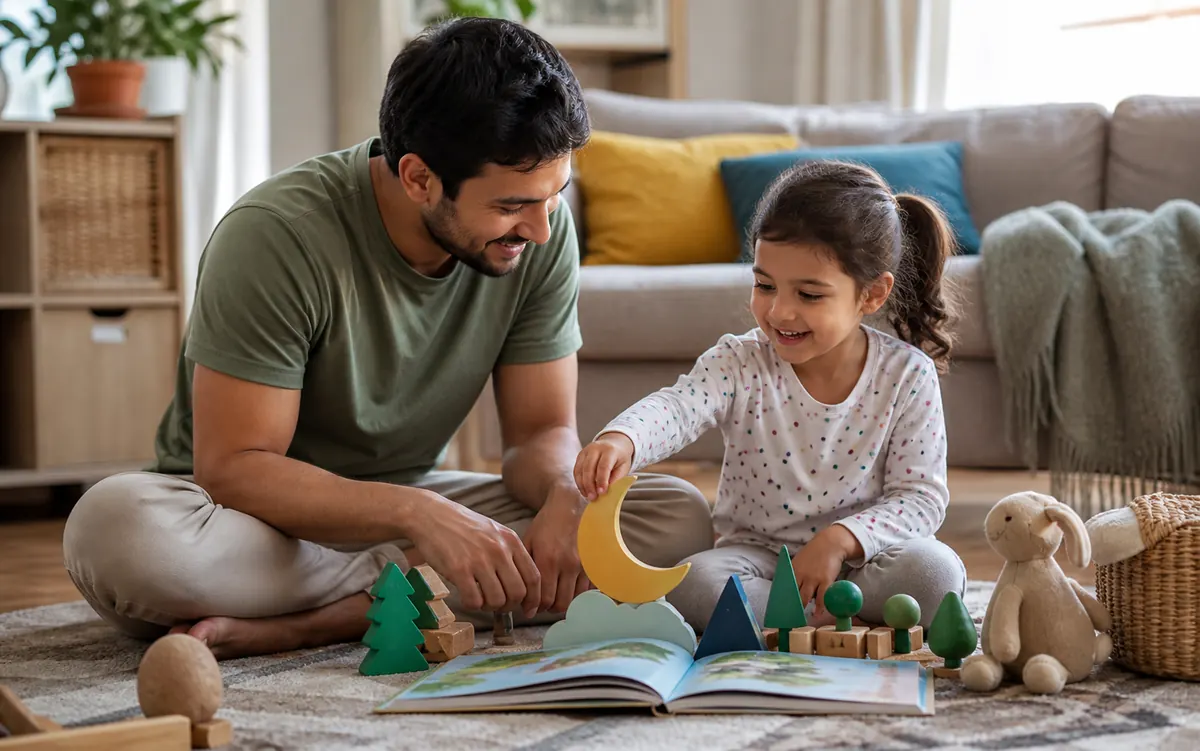
You do not need a craft cupboard or a carefully planned lesson. Toddlers often enjoy repeating a simple action, copying you and deciding what happens next. The American Academy of Pediatrics notes that simple objects such as blocks, empty containers and wooden spoons can support creative play. Your attention matters more than a complicated setup.
Use this guide as a menu, not a schedule. Choose one idea, show the first step and let your toddler change it. If you want stories rather than offline play ideas, compare screen-free and low-screen story formats separately.
Choose an activity in 30 seconds
Swipe or scroll horizontally to compare all columns.
| Activity | Energy | Setup | You need |
|---|---|---|---|
| Animal-walk parade | High | None | Open floor |
| Cushion stepping path | High | 3 minutes | Firm cushions |
| Laundry delivery | High | 2 minutes | Basket, soft clothes |
| Clap-and-freeze dance | High | None | Your hands |
| Follow the line | Medium | 2 minutes | Painter's tape or a floor line |
| Cardboard-box bus | Medium | 3 minutes | Large box |
| No-button sock puppet | Medium | 1 minute | Clean sock |
| Pretend shop | Medium | 5 minutes | Large safe objects, bag |
| Toy rescue mission | Medium | 3 minutes | Favourite toys |
| Act out one story scene | Medium | 2 minutes | Book or known story |
| Large-object colour sort | Quiet | 3 minutes | Bowls, large objects |
| Cup stack and nest | Quiet | None | Plastic cups |
| Tear-and-stick collage | Quiet | 5 minutes | Paper, child-safe glue |
| Crayon treasure map | Quiet | 2 minutes | Paper, large crayons |
| Picture-book hunt | Quiet | None | Favourite book |
| Rhyme and actions | Flexible | None | A familiar rhyme |
| Water transfer | Quiet | 5 minutes | Shallow tray, cups, towel |
Active screen-free activities
Clear a safe patch of floor and stay close. These activities give busy bodies a job without turning your home into an obstacle course.
1. Animal-walk parade
How to start: Name an animal and move like it from one side of the room to the other. Waddle like a duck, stomp like an elephant or crawl like a cat. Let your toddler choose the next animal and lead the parade.
Make it easier: Stay in one place and copy only the animal's sound or arms.
2. Cushion stepping path
How to start: Place two or three firm cushions flat on a non-slip floor. Hold your toddler's hand as they step from one “island” to the next. Move the final cushion to make a new route.
Safety: Keep the path low, avoid slippery rugs and remove nearby furniture with hard edges. Skip jumping from sofas, beds or stacked cushions.
3. Laundry delivery
How to start: Put a few socks or small towels in a light basket. Ask your toddler to deliver one item to a chair, a bed or you. Name the item or colour as it travels.
Let them lead: Your child can invent the delivery address and decide whether the next sock travels by train, tiptoe or bear walk.
4. Clap-and-freeze dance
How to start: Make a beat by clapping or tapping your knees. Your toddler moves while the beat continues and freezes when you stop. Swap roles so your child controls the sound.
Quieter version: Wiggle fingers instead of dancing, then hide both hands when the beat stops.
5. Follow the line
How to start: Follow an existing tile edge or place a short strip of low-tack painter's tape on a suitable floor. Walk beside it, step over it, drive a toy along it or balance a soft toy next to it.
Safety: Check that the tape will not damage the surface, press it flat and remove it after play.
Pretend-play activities with household items
Try setting out one open-ended object instead of explaining a whole game. The CDC suggests pretend play for toddlers, and UNICEF includes dress-up, sock puppets and family music among its screen-free ideas.
6. Cardboard-box bus
How to start: Use a sturdy box large enough for your toddler to sit in comfortably. Pretend to drive to the kitchen, the moon or a grandparent's house. Take turns being the driver and announcing the next stop.
No box? Two chairs on the floor can be the front and back of the bus. Avoid closing a child inside a box.
7. No-button sock puppet
How to start: Pull a clean sock over your hand and give it a voice. The puppet can ask for breakfast, look for a toy or make a silly mistake for your toddler to correct.
Keep it simple: Do not add buttons, beads or other small decorations. Your hand and voice are enough.
8. Pretend shop
How to start: Put three to five large, safe household items on a low table. Offer a reusable bag and take turns being the shopper. Ask for “the soft towel” or let your toddler decide what the shop sells.
Skip pretend coins: Small discs can be a choking risk. A spoken “thank you” works as payment.
9. Toy rescue mission
How to start: Place two favourite toys in easy-to-see spots. Tell your toddler, “Bear needs a ride home,” or “Rabbit is waiting under the chair.” Use a towel as a stretcher or a basket as a rescue vehicle.
Add a choice: Ask which toy needs help first rather than hiding lots of objects around the house.
10. Act out one story scene
How to start: Choose one familiar moment: knock on a pretend door, make tea for a toy or help a character cross a river made from a towel. Your toddler can play a character, move a toy or simply watch you begin.
For more variations, use our guide to simple story role play for kids. Keep the scene short and let your child change the ending.
Quiet activities for slower moments
Quiet does not have to mean silent or perfectly focused. Sit nearby, describe what your toddler is doing and allow repetition. When you want a full menu for slower daytime moments, choose from these low-mess quiet time activities for toddlers.
11. Large-object colour sort
How to start: Choose six to eight large, child-safe objects in two colours, such as washcloths, chunky blocks or large plastic cups. Place them into two bowls together.
Follow your child: If sorting is not interesting, stack the objects, line them up or talk about how they feel.
12. Cup stack and nest
How to start: Offer three or four lightweight plastic cups. Build a tower, hide one cup under another or fit smaller cups inside larger ones. Pause before the last cup so your toddler can finish.
Try one question: “Which cup fits?” is enough. This is play, not a test.
13. Tear-and-stick collage
How to start: Tear scrap paper together and stick the pieces onto a larger sheet with washable, non-toxic child-safe glue. Make a road, a rain cloud or an abstract patchwork.
Safety: Supervise closely and put scraps away when finished, especially if your toddler still mouths objects.
14. Crayon treasure map
How to start: Draw a simple line from the sofa to a toy basket and add a large X. Walk the route together, then let your toddler scribble a new path for you to follow.
Use: Large, age-appropriate crayons and paper secured on a child-safe surface.
15. Picture-book hunt
How to start: Open a familiar picture book and look for one kind of thing: animals, circles, hats or something blue. Point, name and turn the page when your toddler is ready.
You can also pause and wonder what a character might do next. Our toddler read-aloud guide has more ways to invite a child into the story without quizzing them.
16. Rhyme and actions
How to start: Say a familiar rhyme slowly and add one action: twinkle fingers, row your arms or clap a steady beat. Leave a pause before one repeated word and let your child join only if they want to.
Need a rhyme you already know? Try one of these nursery rhymes with simple toddler actions.
A closely supervised water activity
17. Water transfer with cups
How to start: Put a small amount of water in a shallow tray on the floor or in a dry bathtub. Offer two unbreakable cups and show how to pour from one to the other. Add a towel for wiping spills together.
Stay within arm's reach: Give water play your full attention, even when the water is shallow. Empty the tray and cups immediately when play ends. The U.S. Consumer Product Safety Commission advises caregivers to empty water from containers and supervise young children around water.
A quick safety check before you begin
- Match the materials to your child. Follow age guidance and consider what your child can safely handle, not only the suggested age.
- Keep small parts away. Avoid beads, buttons, coins, water beads, button batteries and toys with loose small pieces.
- Stay close. Active play, crafts and all water activities need hands-on adult supervision.
- Clear the area. Move hard-edged furniture, hot drinks, cords and breakable objects away from movement games.
- Use child-safe materials. Choose washable, non-toxic art supplies and unbreakable containers.
- Stop when it stops working. A toddler who mouths materials, throws hard objects or becomes overwhelmed needs a simpler activity or a break.
If you are unsure whether a toy or material suits your child, check its current safety guidance and packaging. The U.S. Consumer Product Safety Commission's toy safety guidance is a useful starting point.
How to make an activity last without taking it over
- Offer one clear start. Demonstrate the first pour, stomp or delivery.
- Describe instead of directing. “You put the blue cup on top” leaves more room than constant instructions.
- Repeat before adding. Toddlers often want the same action again. You do not need to introduce a new challenge.
- Add one small change. Move the basket, swap roles or choose a new animal.
- End while it is still manageable. Invite your toddler to put one item away with you, then move on.
Questions parents often ask
What are easy screen-free activities for toddlers at home?
Easy options include animal walks, a clap-and-freeze dance, a cardboard-box bus, pretend shop, cup stacking, a picture-book hunt and drawing a simple treasure map. Choose one that matches your toddler's energy and use large, age-appropriate materials.
How long should a toddler activity last?
There is no single required length. A few engaged minutes can be enough. Continue while your child is interested, offer a small change if play stalls and stop before either of you becomes frustrated.
Which toddler activities need no preparation?
Animal walks, follow-the-line movement, clap-and-freeze dancing, a picture-book hunt and a familiar rhyme with actions can all start almost immediately.
How can I keep at-home toddler activities safe?
Stay close, match materials to your child's age and abilities, keep small parts and button batteries out of reach, clear movement areas and supervise water continuously. Empty water containers as soon as play ends.
Does reading a story from a phone count as a screen-free activity?
No. Reading from a phone still uses a screen, even when a parent leads the experience. For a completely screen-free story activity, choose a printed book, tell a story from memory or act out a familiar tale. Our guide to phone reading and screen time explains the distinction.
Sources and further reading
- CDC: Positive Parenting Tips, including the toddler age guides.
- American Academy of Pediatrics: The Power of Play.
- UNICEF Parenting: Screen-Free Activities for Children.
- U.S. Consumer Product Safety Commission: Toy Safety.
- U.S. Consumer Product Safety Commission: In-Home Water Safety.
Turn a shared story into your next activity
Baboo Stories gives parents stories to read aloud from a phone. It is phone-based parent-led reading, so it is not screen-free. You can read together, put the phone away, then act out one scene with toys or make up a new ending.
The app is free to download. Some stories are locked, and an optional monthly subscription unlocks all stories.