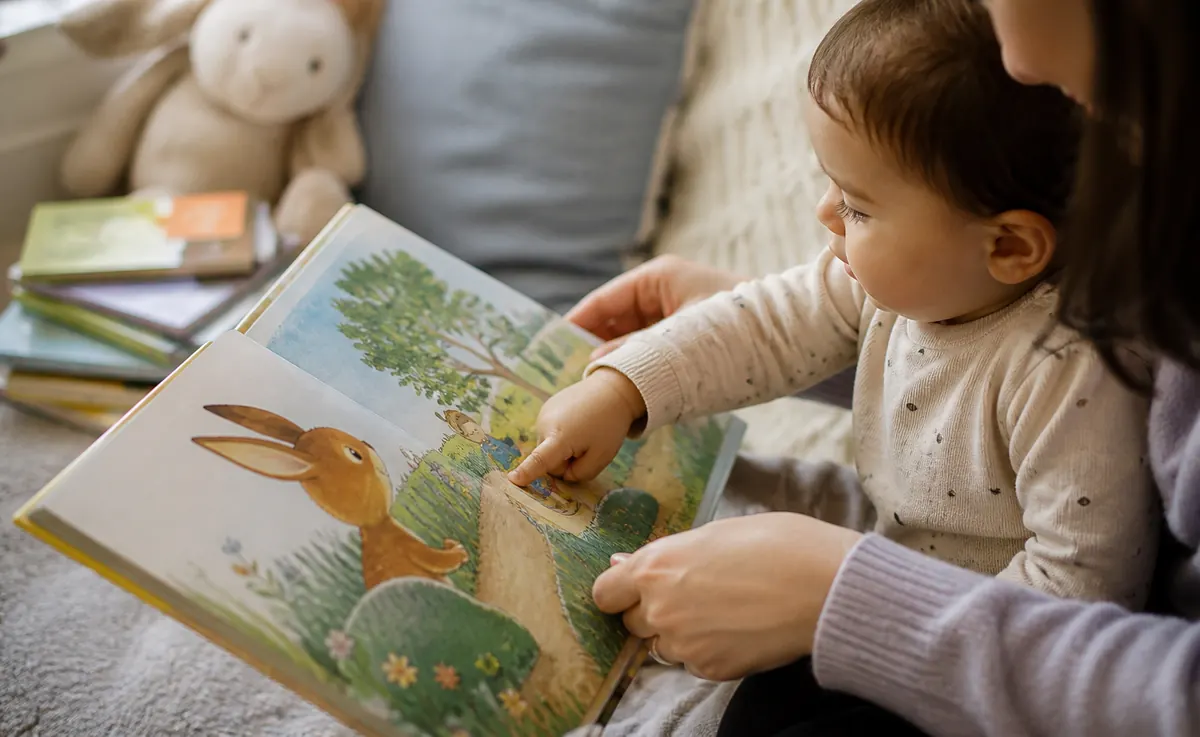
You open the book. Your toddler climbs into your lap. For one glowing second, it looks like the picture you had in your mind: soft light, small pajamas, a story before sleep.
By page two, your child is upside down on the sofa. By page three, the bear in the book has become a dinosaur. By page four, the book is closed, reopened backwards, and used as a roof for a tiny house.
Many parents look at that scene and think, I am doing this wrong. They worry their toddler is not ready for books, that they chose the wrong story, or that reading aloud only counts if a child sits quietly from beginning to end.
It has not gone wrong.
Toddlers are not miniature schoolchildren. They are moving, pointing, interrupting, pretending, testing, laughing, resisting, repeating, and connecting. That is not the opposite of learning. It is how early learning looks before it becomes neat enough for a classroom worksheet.
The real question is not how to make a toddler sit still for a book. The better question is how to read aloud to toddlers in a way their growing brains can actually use.
The answer is interactive reading: a style of reading with toddlers where the parent remains the storyteller, but the child becomes a participant. You still read. You still guide. But you also pause, wonder, respond, act, repeat, and let the story breathe.
This guide gives you a practical, research-backed way to do that, without turning story time into a lesson and without handing the moment over to autoplay videos. Baboo Stories exists for the same reason: to help parents tell stories with their children. The parent is still the voice, the warmth, the pace, and the safe place. The tool only supports the storyteller.
Table of Contents
- Why toddlers read differently than adults expect
- What interactive reading actually means
- Why reading aloud builds connection before literacy
- The Baboo READ Method
- R - React: follow the spark
- E - Explore: ask better story questions
- A - Act: move, voice, gesture, and play
- D - Dream: imagine beyond the page
- How the READ Method fits into one story time
- There is no perfect way to read a story
- Story time through a toddler's eyes
- Reading to a two-year-old
- Reading to a three-year-old
- Reading to a four and five-year-old
- Story time isn't sitting still
- What great storytellers actually do
- The Baboo Story Session
- Five story time mistakes nearly every parent makes
- Mini expert tips
- Why toddlers learn through stories
- Why toddlers love hearing the same story again
- Why children interrupt every page
- Why character voices matter
- Why acting out stories supercharges learning
- The difference between reading and performing
- Reading from a phone does not have to mean screen time
- Story time around the world
- What research really says
- Case studies
- Research summary
- Myth vs fact
- Your first week of interactive reading
- 100 story questions
- The character voice guide
- The Baboo Story Cards
- Story time routines
- Reading milestones
- Frequently asked questions
- Build a storytelling habit
- Why Baboo Stories exists
- Resource library
- Living resource
- The Parent Storytelling Library
- 365 story starters
- The ultimate question library
- Emotion guide
- Storytelling games
- Seasonal story ideas
- Expert corner
- Frequently updated research
- Community stories
- The interactive storytelling hub
- Supporting article roadmap
- Article version history
Why Toddlers Read Differently Than Adults Expect
Adults often imagine reading as a quiet activity. Sit down. Open the book. Start at the beginning. Read every word. Turn pages in order. Finish.
Toddlers experience books differently. A book is an object, a rhythm, a set of pictures, a chance to hear your voice, a reason to ask for the cow sound again, a doorway into pretend play, and sometimes something to carry around while shouting "truck!"
That difference matters because frustration often begins when a parent expects adult reading behavior from a child whose brain is still learning attention, language, impulse control, and symbolic thought. A 2-year-old may listen deeply while standing up. A 3-year-old may understand a story better when they interrupt to explain the picture. A preschooler may need to retell the plot with every character renamed after family members.
Reading with toddlers works best when we stop measuring success by stillness and start noticing signs of engagement: pointing, naming, repeating, laughing, predicting, acting, looking back at you, and asking to hear the same page again.
What Interactive Reading Actually Means
Interactive reading is not a complicated program. It is simply a shift from reading at a child to reading with a child.
In a traditional read-aloud, the adult carries almost everything. The child listens. In interactive reading, the adult still leads, but the child gets many small chances to participate. They can point to the moon, roar for the bear, choose which door the character opens, predict what happens next, or connect the picture to yesterday's trip to the park.
This is close to what researchers and educators often call dialogic reading: the adult uses prompts, expansions, praise, repetition, and open-ended conversation so the child gradually becomes more of the storyteller. The goal is not to interrogate the child. The goal is to invite language.
A helpful test is this: after a page, ask yourself, "Did my child have a way to get into the story?" If yes, you are reading interactively.
| Less Helpful | More Interactive | Why It Works |
|---|---|---|
| "What color is this? What animal is this? What letter is this?" | "This fox looks surprised. What do you think he heard?" | Invites thinking, vocabulary, emotion, and imagination. |
| "Sit still. I'm reading." | "Can you tiptoe like the mouse while I read this page?" | Uses movement as participation instead of treating it as failure. |
| "No, that's not what happens." | "That would be funny. In this story, the rabbit tries something else." | Protects creativity while gently returning to the plot. |
| "Let's finish the whole book." | "Let's read two more pages and choose our favorite picture." | Respects toddler attention and ends with success. |
Why Reading Aloud Builds Connection Before Literacy
Parents often come to reading aloud because they want their child to learn words, enjoy books, and be ready for school. Those are reasonable hopes. But the first gift of reading books together is relational.
A toddler hears your voice slow down. They feel the pause before a surprise. They notice that you saw what they saw in the picture. They learn that their pointing matters because you respond. The book becomes a small shared world where parent and child can meet.
This is why parent-led storytelling is so different from passive autoplay. A video can deliver plot. It cannot notice that your child whispered "baby" when a small character appeared. It cannot pause because your toddler is thinking. It cannot connect the moon in the story to the moon you saw through the car window.
Parents are the storytellers because parents are responsive. That responsiveness is the heart of early learning.
The Baboo READ Method
The Baboo READ Method is a simple framework for how to make story time interactive without overthinking every page. It gives parents four moves to return to whenever a toddler wiggles, interrupts, or seems more interested in the picture than the plot.
The method is not a script. It is a rhythm:
flowchart LR R["R: React
Notice the child's spark"] --> E["E: Explore
Open the conversation"] E --> A["A: Act
Bring the story into the body"] A --> D["D: Dream
Imagine beyond the page"] D --> R
| READ Step | Parent Move | Toddler Experience |
|---|---|---|
| React | Pause and respond to what caught your child's attention. | "My idea matters." |
| Explore | Ask open-ended questions, expand words, and wonder aloud. | "I can think and talk about stories." |
| Act | Add voices, gestures, movement, sounds, and pretend play. | "Stories live in my body and imagination." |
| Dream | Invite predictions, new endings, and real-life connections. | "I can create meaning too." |
You can use all four steps in a single book, or just one step on a tired night. The method works because toddlers do not learn best from uninterrupted adult performance. They learn through shared attention, repetition, conversation, movement, and emotional safety.
R - React: Follow the Spark
React means you notice what captures your child's attention before you rush to the next sentence. It is the most important skill in interactive reading because it tells the child, "I see what you see."
The spark might be a picture, a sound, a feeling, a word, a memory, or a tiny detail you would have skipped. Your toddler points to the puppy in the corner of the page while you are reading about the moon. Reacting means you pause and join the child at the puppy before you guide them back to the moon.
This does not mean your toddler takes over every moment. It means their attention becomes useful information. When you follow it, reading aloud becomes a shared activity instead of a parent pushing through text while a child tries to pull the experience somewhere else.
Why React Works Psychologically
Toddlers are building joint attention: the ability to share focus with another person. When your child points and you respond, you create a triangle between child, adult, and object. That triangle is powerful. It lets the child connect language to something they care about in the moment.
Reacting also lowers pressure. A toddler who feels corrected or hurried may resist the book. A toddler who feels noticed often stays longer, even if "staying" looks like standing beside you and leaning in for the good pages.
For parents, React is a relief. You do not have to keep story time on rails. You only have to notice the child's spark and make one warm connection before continuing.
What React Sounds Like
Imagine you are reading a book about a lost bear. Your child ignores the bear and points to a tiny red boot.
Child: Boot!
Parent: You found a boot. A very small red boot.
Child: Mine boot.
Parent: You have boots too. Your yellow rain boots. Do you think the bear lost this one?
Child: Bear boot!
Parent: Maybe. Let's see where the bear walks next.
Notice what happened. The parent did not abandon the story. The parent used the child's interest as a doorway back into the story.
Parent Example: The Page-Grabbing Toddler
Page grabbing is one of the most common story time struggles. A parent begins reading, and the toddler flips ahead, flips back, or shuts the book with dramatic finality.
React first. Then guide.
Parent: You really want the page with the train. Let's visit the train for a minute.
Child: Choo choo!
Parent: Choo choo. The train is loud. After the train page, I will turn one page.
The boundary is still there. The difference is that the child is met before being redirected.
Mini Tips for React
- Pause for three seconds when your child points, laughs, or repeats a word.
- Name what your child noticed before adding your own idea.
- Use phrases like "You saw..." and "You noticed..." to make attention visible.
- Let a favorite page become the story for the night when your child is tired.
- Remember that reacting to movement can count: "You're jumping like the frog."
Common Mistakes in React
The first mistake is rushing. Many parents feel pressure to finish, especially when a book has a clear plot. But for toddlers, a single page can be rich enough for one meaningful exchange.
The second mistake is correcting too quickly. If your child calls a fox a dog, you can expand gently:
Child: Dog!
Parent: It does look like a dog. This animal is called a fox. Foxes have pointy ears.
The third mistake is treating interruptions as disrespect. With toddlers, interruptions are often bids for connection. They are saying, "I have something to add." Reacting teaches them how shared conversation works.
E - Explore: Ask Better Story Questions
Explore means you use the book as a place for thinking, not testing. This is where many parents accidentally make story time feel like school. They ask too many closed questions:
- "What color is this?"
- "How many apples?"
- "What letter is that?"
- "What animal is this?"
These questions are not bad. They can be useful in small doses. But if every page becomes a quiz, toddlers often lose the pleasure of the story. Explore asks a different kind of question: one that opens the child's mind rather than checking an answer.
The best story questions for toddlers are often simple, emotional, and imaginative:
- "What do you think she wants?"
- "Where could the puppy hide?"
- "How does his face look?"
- "What would you do?"
- "Why is everyone so quiet?"
Why Explore Works in the Brain
Language grows through meaningful back-and-forth. A toddler needs to hear words, but they also need chances to use words, gestures, sounds, and early sentences in a conversation that matters to them.
Open-ended questions create those chances. They invite expressive language, memory, prediction, emotional labeling, and problem solving. When you expand your child's answer, you add vocabulary right at the point of interest.
This is the heart of dialogic reading. The adult prompts the child, evaluates gently, expands the response, and repeats or revisits the idea. In parent language: ask, listen, add, and keep the story warm.
The Difference Between Quiz Questions and Story Questions
| Quiz Question | Story Question | Parent Expansion |
|---|---|---|
| "What color is the ball?" | "Where do you think the ball will roll?" | "Down the hill. Fast, fast, fast." |
| "Is this a rabbit?" | "What do you think the rabbit is hiding?" | "A dinosaur would be a surprising thing to hide in a basket." |
| "How many ducks?" | "Which duck looks worried?" | "This little duck's eyes are wide. Maybe she lost her mama." |
| "What letter is this?" | "This word says splash. Can you make a splash sound?" | "Splash is a wet, noisy word." |
Real Dialogue: Exploring Without Pressure
Parent: What do you think the rabbit is hiding?
Child: A dinosaur!
Parent: What if you're right? That basket would shake and shake.
Child: Big dinosaur.
Parent: A huge dinosaur hiding in a tiny basket. Should we peek?
The child's answer does not have to be realistic. The point is that the child is thinking with language. If the story later reveals a carrot, you can keep both realities alive:
Parent: Oh, it was a carrot in this book. But your dinosaur basket story was excellent.
Mini Tips for Explore
- Ask fewer questions than you think you should.
- Use comments as often as questions: "That bear looks unsure."
- Wait after asking. Toddlers often need extra time.
- Accept gestures, sounds, and one-word answers as real responses.
- Expand one step beyond your child's language, not five steps beyond it.
Common Mistakes in Explore
The most common mistake is asking questions you already know the answer to over and over. Toddlers sense when a question is really a test. They may comply for a while, but the joy thins out.
Another mistake is correcting imagination. If a toddler says the moon is a cookie, you can enjoy the metaphor before naming reality:
Parent: It does look like a cookie. A round, glowing moon-cookie. In the story, it is the moon.
A third mistake is making every page a discussion. Interactive reading still needs flow. Sometimes the best thing to do is read two pages without stopping, especially when the rhythm of the words is carrying your child.
A - Act: Bring the Story Into the Body
Act means you let the story become physical. Toddlers are embodied learners. They understand the world through climbing, touching, carrying, stomping, whispering, spinning, hiding, feeding dolls, and pretending to sleep for exactly two seconds before popping back up.
If we ask toddlers to leave their bodies behind during reading, we often lose them. If we invite the body into the story, attention returns.
Acting can be tiny. A whisper for the sleeping mouse. A paw gesture for the bear. A slow blink for the owl. A finger walk across the page. It can also be big: stomping like a giant, crawling through an imaginary tunnel, or making soup in a pretend pot after the book ends.
Why Act Works Developmentally
Pretend play is one of the great engines of early childhood. It lets children practice symbols: this block is a phone, this blanket is a cave, this parent is a dragon, this page is a forest. Reading aloud already asks a child to think symbolically. Acting gives that symbolic thought a body.
Movement also helps attention. A toddler who cannot sit still may still be able to listen while doing a repeated action. The movement becomes a bridge into the story rather than a competing activity.
You may hear people connect imitation and learning to mirror neuron systems. The parent-friendly takeaway is simple: children learn a lot by watching and copying meaningful actions. When you model a character's stomp, whisper, sadness, surprise, or bravery, your child gets a concrete way to enter the story.
Character Voices Without Performing
Many parents freeze at the phrase "use character voices." They imagine theatrical range, accents, and pressure to entertain. That is unnecessary. A character voice can be one small change:
- The tiny character speaks softly.
- The giant speaks slowly.
- The sleepy character yawns between words.
- The excited character speaks a little faster.
- The worried character repeats, "Oh no, oh no."
Toddlers do not need polished acting. They need contrast. They need your face and voice to show that something is happening.
Real Dialogue: Acting Out a Page
Parent: The little bear tiptoed through the forest.
Child: Tiptoe!
Parent: Show me tiny tiptoe feet.
Child: [walks on toes]
Parent: So quiet. Now the bear heard a sound. Freeze!
Child: [freezes, laughing]
That is reading aloud. It is not separate from literacy. It is a toddler-sized path into comprehension.
Story Time Ideas for Act
- Sound buttons: Choose one repeated sound your child makes every time a character appears.
- Gesture words: Add a hand motion for big, tiny, fast, slow, up, down, open, and closed.
- Prop of the night: Use one sock as a puppet, one spoon as a magic wand, or one blanket as a boat.
- Freeze page: When something surprising happens, everyone freezes before turning the page.
- Walk the story: After reading, take three steps that match the beginning, middle, and end.
Common Mistakes in Act
The first mistake is making the activity too elaborate. If you build a full craft project every time you read, story time becomes hard to repeat. Keep the action small enough for a tired Wednesday.
The second mistake is using movement without returning to the book. A little acting helps attention; unlimited acting can pull the child completely away. Use a simple loop: read, act, return.
The third mistake is choosing actions that wind your child up right before bed. Big stomping may be wonderful at 4 p.m. At bedtime, choose tiny acting: whispering, slow breathing, finger walking, soft animal sounds, or pretending to tuck a character in.
D - Dream: Imagine Beyond the Page
Dream means you invite your toddler to move from the story as written into the story as imagined. This is where interactive storytelling becomes especially powerful. A child predicts, invents a new character, changes an ending, connects the plot to home, or asks a strange question that makes perfect toddler sense.
Dreaming does not replace the book. It extends the book. It tells the child, "Stories are not only things we consume. Stories are things we can think with."
This step is also where Baboo Stories naturally fits. A parent can use Baboo to find a gentle story idea, a character, or a prompt. But the parent remains the storyteller. The magic is not that a device performs for the child. The magic is that a parent has a little support for creating a richer back-and-forth.
Why Dream Works
Toddlers are beginning to practice mental time travel: remembering what happened, anticipating what might happen, and imagining what could happen if the story changed. These are early forms of narrative thinking.
When a child predicts an ending, they are using memory and logic. When they invent a character, they are using symbolic thought. When they connect a story to their own life, they are building meaning. When they retell the story later with wildly inaccurate but emotionally true details, they are practicing ownership.
Dream also protects joy. A toddler who is allowed to imagine is more likely to see books as living things, not assignments.
Real Dialogue: Dreaming a New Ending
Parent: The owl found his way home. What do you think he did next?
Child: Eat pancakes.
Parent: Night pancakes. Excellent choice.
Child: With Mama.
Parent: With Mama Owl. Should Papa Owl make tiny pancakes or giant pancakes?
Child: Giant!
This conversation may look silly from the outside. Inside it are sequencing, emotional closure, family connection, adjectives, choice making, and the feeling that stories belong to the child too.
Dream Prompts Parents Can Use Tonight
- "What could happen after the last page?"
- "Who else should be in this story?"
- "What would happen if the tiny mouse became enormous?"
- "Where would this character sleep in our house?"
- "What snack would you bring for the dragon?"
- "Can we make up one more page?"
- "What should the character say now?"
Connecting Stories to Real Life
Toddlers understand stories more deeply when the story touches something they know. If a character is nervous about school, connect it to saying goodbye at daycare. If a story includes rain, remember the puddle outside. If a character shares a toy, talk about the truck your child wanted yesterday.
Keep these connections gentle. The story should not become a moral lecture. A child does not need, "See, the rabbit shared, so you should share with your sister." Try, "The rabbit is trying to share. Sharing can feel hard when you love the toy."
Common Mistakes in Dream
One mistake is treating invented answers as wrong. If the child predicts that the rabbit will fly to the moon, that answer may be impossible, but it is not useless. It gives you language to build on: fly, moon, high, far, rocket, helmet, brave.
Another mistake is asking for too much story invention too soon. A young 2-year-old may not answer, "What should happen next?" They may do better with two choices: "Should the bear knock on the door or hide under the blanket?"
A third mistake is letting the invented story become endless at bedtime. Dream can be bounded:
Parent: Let's make one extra page, then the story goes to sleep.
How the READ Method Fits Into One Story Time
The Baboo READ Method is easiest to understand in motion. Here is how a five-minute toddler story time might look with all four steps included.
| Minute | What the Parent Does | READ Step |
|---|---|---|
| 0:00-1:00 | Lets the toddler choose between two books and names the cover details the child points to. | React |
| 1:00-2:30 | Reads a few pages, pauses for one open-ended question, and expands the child's answer. | Explore |
| 2:30-4:00 | Adds a repeated whisper, roar, tap, or gesture every time a character appears. | Act |
| 4:00-5:00 | Asks what might happen after the story ends and adds one sentence to the child's idea. | Dream |
On another night, you may only React. On a long weekend morning, you may Act and Dream for twenty minutes. The method is flexible because family life is flexible. A pillar habit cannot depend on perfect conditions.
There Is No Perfect Way to Read a Story
Some children melt into your lap and listen with their whole body. Some run laps around the sofa while somehow remembering exactly where the blue truck appears. Some interrupt every page. Some want the same book six nights in a row and still act shocked when the caterpillar eats the pear.
All of these can be normal. When parents ask how to read to a toddler, they are often really asking, "How do I know if this is working?" The answer is not, "Did we finish the book?" A better measure is, "Did we enjoy the experience together?" Did your child look, point, laugh, answer, copy a sound, lean closer, calm down, or ask for one more page? Those are success signs.
Story Time Through a Toddler's Eyes
Adults think, "I'm reading." Toddlers think, "I'm exploring." They are exploring the page, your voice, the feeling in the room, the flap that opens, the word that sounds funny, and the delicious fact that they can make you roar again by pointing at the bear.
Curiosity comes first. Movement often helps them regulate. Emotion tells them what matters. Play gives the story meaning. Repetition gives them mastery. This is why interactive story time works so well for ages 2 to 5: it matches the way young children learn.
A helpful mental shift is to treat the book as the shared meeting place, not the whole event. The picture may start the conversation. Your voice may carry the feeling. Your child's stomp, gasp, or invented answer may become the moment they remember. When reading books aloud works this way, the story is still respected, but the relationship stays in the center.
Reading to a Two-Year-Old
Reading to a 2 year old is usually short, sensory, and wonderfully uneven. Attention may last two minutes or twelve. Many 2-year-olds want board books, predictable phrases, pictures they can name, animal sounds, vehicles, babies, food, bedtime, and anything that connects to their own day.
Use simple language, but do not flatten it. Read a line, then add a small comment: "The dog is enormous. That means very, very big." Point as you speak. Let your child touch sturdy pages. Invite one sound or movement per page: stomp, beep, munch, splash, hush.
Parent: The cow is looking over the fence.
Child: Moo!
Parent: Moo. A loud cow. What does the tiny calf say?
Child: Baby moo.
Developmentally, success may look like pointing, naming one object, turning pages, repeating a sound, sitting for only part of the book, or bringing the book back later. The common mistake is expecting too much plot. For many 2-year-olds, one picture explored well is more useful than ten pages rushed.
Mini case study: Maya's father worried because she never let him finish Goodnight Farm. She only wanted the sheep page. He stopped fighting it and made the sheep page interactive: counting, whispering, finding the moon, saying goodnight. After a week, Maya began turning to the next page herself.
Reading to a Three-Year-Old
Reading to a 3 year old often becomes more dramatic. Three-year-olds may ask "why," remember repeated phrases, correct you if you skip a sentence, and turn a quiet story into a rescue mission. This is a gift. It means the story is becoming something they can hold, change, and retell.
Give them predictable jobs. They can say the repeated line, knock on the pretend door, guess what is inside the box, or choose the voice for a character. Ask prediction questions, but keep them concrete: "Will the fox hide under the bed or behind the tree?" Build memory gently: "What happened to the hat before?"
Parent: The dragon heard a tiny knock.
Child: It's the bunny.
Parent: You remembered the bunny from the last page. What should the dragon say?
Child: Come in, bunny.
Good storytelling activities for this age include acting out one scene, drawing a favorite character after the book, making a new silly title, or retelling the story with toys. The common mistake is treating questions as delays. Often, a 3-year-old's question is the work of comprehension happening out loud.
Reading to a Four and Five-Year-Old
Reading to preschoolers can become richer because 4- and 5-year-olds are ready for motives, feelings, problems, and invented endings. They can often follow a longer plot, remember what happened yesterday, and explain why a character made a choice.
This is the age to ask questions during story time that invite reasoning: "Why did she hide the map?" "What could he try next?" "Was that fair?" "How do you know he feels lonely?" When your child answers, stretch the idea without taking it over.
Child: He is mad because nobody listened.
Parent: Yes. His eyebrows look tight, and he walked away. What could his friend do now?
Child: Say sorry and give him the shovel.
Preschoolers also love making connections. "This reminds me of when you felt nervous before the birthday party." Keep the tone gentle, especially around behavior. Stories help children think about hard feelings safely; they should not become lectures disguised as books.
Try creating characters together. Give your child three choices: a tiny chef, a sleepy astronaut, or a brave umbrella. Ask where the character lives, what problem they have, and who helps. This is storytelling, vocabulary, sequencing, and emotional practice in one playful conversation.
Mini case study: Leo, age 5, kept changing endings. His mother worried he was not listening. She started saying, "First let's hear the author's ending, then Leo's ending." He listened more closely because his version had a promised place.
Story Time Isn't Sitting Still
If your child won't sit still, it does not automatically mean your toddler won't listen. Many active toddlers listen while walking, jumping, coloring, hugging a toy, lining up cars, or building blocks nearby. Their bodies are busy because their nervous systems are still learning how to organize attention.
Try creating a "listening lane." Your child may move within a small area while you read. Offer quiet hands-on options: a soft toy that matches the story, blocks for building the castle, crayons for drawing the character, or a blanket cave for the bear. Then check for listening with warmth, not suspicion.
Parent: I saw you building while I read. What did the mouse find?
Child: Cheese.
Parent: You were listening with busy hands.
What Great Storytellers Actually Do
| Instead of | Try This |
|---|---|
| Reading quickly | Pause dramatically before a surprise: "And behind the door was..." |
| Asking yes/no questions | Ask open questions: "What could happen next?" |
| Correcting every answer | Explore every answer first: "A dinosaur would be hilarious. In this book, it's a rabbit." |
| Finishing every page | Follow curiosity: "You want the rain page tonight. Let's make rain sounds." |
| Using one voice | Change pace, volume, or facial expression for key characters. |
Great storytellers do not perform perfectly. They make space. They wait. They notice the child's answer and build one sentence on top of it.
The Baboo Story Session
A practical story session can take 10 to 15 minutes. Keep it simple enough to repeat on tired nights.
flowchart LR
Choose --> Read
Read --> Pause
Pause --> Ask
Ask --> Act
Act --> Imagine
Imagine --> Hug
Hug --> Finish
Choose one book or parent-led Baboo story prompt. Read slowly. Pause at one interesting picture. Ask one open question. Act out one sound or movement. Imagine one extra detail. End with a hug, closing phrase, or tiny reflection: "My favorite part was your dragon voice."
Five Story Time Mistakes Nearly Every Parent Makes
1. Trying to finish the story
This happens because adults respect books and want completion. But toddlers may get more from three joyful pages than a full book dragged past their limit. Try: "One more page, then we say goodnight to the bear."
2. Reading too quickly
We rush when bedtime is late. The problem is that toddlers need pauses to process pictures, words, and feelings. Try one dramatic silence before a page turn.
3. Treating questions like interruptions
A question is often comprehension in progress. Try: "Good wonder. Maybe the owl is scared. Let's see." Then continue.
4. Thinking movement means inattention
Some children listen better with busy bodies. Try giving a quiet movement job: "Every time I say river, move your hand like water."
5. Making story time a lesson
Teaching sneaks in because parents want to help. But too many drills can flatten joy. Try comments, wonder, and expansion before facts.
Mini Expert Tips
- Pause before turning an exciting page.
- Whisper when you want attention back.
- Use your finger to connect words and pictures.
- Leave silence after a question.
- Act surprised even when you know the ending.
- Ask "why" only when your child has enough language to answer.
- Point to emotions before naming morals.
- Copy animal sounds and let your child lead the volume.
- Offer two books, not the whole shelf.
- Let repeated books do their quiet work.
- Choose bedtime actions that get smaller, not bigger.
- Use one prop instead of a pile.
- Let toddlers stand if they are still engaged.
- Turn mistakes into play: "Oops, I gave the bear a mouse voice."
- Connect one page to your child's real day.
- Stop before everyone is exhausted.
- Invite grandparents or caregivers to use the same repeated line.
- Save big role play for daytime.
- End with the same phrase each night.
- Remember that warmth teaches more than pressure.
Why Toddlers Learn Through Stories
Long before children had shelves of picture books, they had stories. A child learned which berries were unsafe because someone remembered what happened. They learned courage through a tale about a small person facing something large. They learned kindness, family loyalty, danger, cooperation, grief, and belonging through the spoken memories of people who loved them.
That old human pattern still lives inside modern story time. A book gives the parent a structure, but the deeper learning comes from shared meaning. Your toddler hears sequence: first, next, after that. They hear emotion: scared, proud, lonely, relieved. They hear problem solving: the bridge broke, the friend helped, the character tried again. Stories let children practice life at a safe distance.
This is why interactive storytelling reaches so many parts of development at once. Language grows because children hear and use words. Memory grows because stories have patterns. Emotional intelligence grows because characters have feelings. Imagination grows because a child can picture what is not in the room. Executive function grows because the child waits, predicts, shifts attention, and follows a sequence. Empathy grows because a child briefly lives inside someone else's problem.
flowchart TD
Story["Shared story"] --> Language["Language and vocabulary"]
Story --> Memory["Memory and sequence"]
Story --> Emotion["Emotional understanding"]
Story --> Imagination["Imagination and symbolic thought"]
Story --> EF["Executive function"]
Story --> Empathy["Empathy and perspective"]
Parent: The fox felt brave, even though the woods were dark.
Child: I brave at doctor.
Parent: You were brave at the doctor. The fox might need a deep breath like you did.
Why Toddlers Love Hearing the Same Story Again
Parents often think, "I am so tired of this story." Children are experiencing something very different: "I understand more every time." Repetition is not a toddler trying to exhaust you. It is a learning strategy.
The first time through a story, your child may only catch the big shape: a puppy, a door, a funny sound. The second time, they notice the missing shoe. The fifth time, they remember the repeated line. The tenth time, they predict the page before you turn it. Each rereading lowers uncertainty and raises confidence.
Predictability gives toddlers safety. A familiar story has a known beginning, a known worry, and a known repair. That matters in a world where toddlers control very little. The same book lets them feel powerful: they know what is coming, they can join in, and they can correct you with great seriousness if you accidentally skip the page with the moon.
Repetition also builds vocabulary. A new word rarely becomes useful after one exposure. Toddlers need to hear words in context again and again, especially words that do not appear in everyday speech: enormous, tiptoe, worried, disappear, rescue, shimmer. Repeated books give those words stable hooks.
Pattern recognition is another hidden benefit. Rhymes, repeated phrases, page turns, character routines, and story arcs teach children that language has structure. The child who shouts the last word of a repeated sentence is practicing memory, timing, prediction, and participation.
Signs repetition is working include finishing sentences, predicting pages, remembering character names, using a book word later in the day, retelling part of the story with toys, noticing when you change a line, or asking for the same story during a transition. Your adult boredom may be real. So is their learning.
Repetition also helps children notice what changed inside themselves. A page that felt surprising on Monday may feel funny on Tuesday and comforting by Friday. That shift matters. The child is not only memorizing words; they are practicing emotional control with a story they can predict. This is one reason repeated bedtime books can be calming. The ending is known, the parent voice is familiar, and the child's body can begin to trust the rhythm.
Parent: You knew the duck would come back.
Child: Duck always come back.
Parent: Yes. In this story, the duck always comes back. That feels good to know.
Why Children Interrupt Every Page
When children interrupt, adults may hear disruption. Often, the child is processing the story out loud. They are asking a question, making a connection, predicting, testing memory, or bringing their own life into the page.
A useful rule is to honor the first interruption and shape the second. "Yes, you climbed a hill. Now let's see where this hill leads." The child feels heard, and the story keeps moving.
Parent: The rabbit climbed the hill.
Child: I climbed a hill!
Parent: You did. At the park. Your hill was grassy. This rabbit's hill is snowy.
That interruption is valuable. The child connected a story event to personal memory. The parent added comparison language: grassy, snowy. Then the story can continue. Interactive reading does not mean every interruption becomes a ten-minute detour. It means you receive the connection, add language, and gently return.
Why Character Voices Matter
Character voices help toddlers track emotion and attention. A flat reading may still be loving, but a small voice change gives the brain a signal: this character is sleepy, this one is worried, this moment is funny, this page is suspenseful.
| Normal Voice | Character Voice |
|---|---|
| "The tiny mouse said hello." | Use a soft, small voice: "Hello." |
| "The giant knocked on the door." | Slow down and lower your voice: "Knock. Knock. Knock." |
| "The duck was excited." | Brighten your face and pace: "I found it!" |
If you feel embarrassed, take the pressure off. Your child does not care whether you sound like an actor. They care that you are playing. Even a whisper, a pause, or a raised eyebrow can make a character feel alive.
Why Acting Out Stories Supercharges Learning
Acting turns a story from something heard into something lived. Pretend play supports social development because children try on roles. Motor learning supports memory because the body gives the idea another path. Confidence grows because the child gets to do more than answer; they get to become.
This is the Baboo Play Loop:
flowchart TD
Read --> Imagine
Imagine --> Move
Move --> Laugh
Laugh --> Remember
Remember --> Read
Read a small moment. Imagine what it feels like. Move it into the body. Laugh together. Remember it later. A child who tiptoes like a mouse is more likely to remember the mouse, the word tiptoe, and the feeling of being part of the story.
The Difference Between Reading and Performing
Reading is not the same as performing. Performing asks, "Was I good enough?" Interactive reading asks, "Were we connected?" The less helpful pattern is read, turn page, read, turn page, finish. The better pattern is pause, whisper, laugh, point, ask, pretend, return.
Children remember the moment you gasped before opening the pretend cave. They remember being allowed to say the dragon line. They remember that you laughed at their invented ending. The story is the path; the relationship is the place they arrive.
Reading From a Phone Does Not Have to Mean Screen Time
Many parenting articles treat screens as one category. But passive watching is not the same as parent-led digital reading. If a video autoplays and the child watches alone, the screen is leading. If the parent holds the phone, keeps eye contact, reads aloud, pauses, asks questions, uses voices, and invites imagination, the parent is leading.
This is an important distinction for modern families. Sometimes the phone is where the story is. The question is whether the child is interacting primarily with the device or with the parent. Baboo Stories is designed to support the second pattern: parent-led storytelling where the adult voice, pace, warmth, and questions remain central.
Story Time Around the World
Interactive storytelling is not a trend. It is a human tradition. In Japan, kamishibai used illustrated story cards and a live narrator. Across many African oral storytelling traditions, stories are carried through rhythm, call-and-response, proverbs, song, and community memory. In Sri Lanka, folktales often pass values, cleverness, family lessons, and humor through spoken retellings. In Scandinavia, nature stories frequently help children notice forests, weather, animals, seasons, and outdoor life. Indigenous storytelling traditions around the world often connect children to land, ancestors, identity, responsibility, and relationship.
The details differ, but the pattern is familiar: an adult tells, a child responds, the story changes slightly in the living moment, and belonging gets passed along with language.
What Research Really Says
The research does not say parents need perfect voices, expensive materials, or long lessons. It points toward a simpler conclusion: children benefit when caring adults share books and stories in responsive, language-rich ways.
Dialogic reading shows the value of prompting children, expanding their answers, and helping them become active participants. Reach Out and Read shows that guidance, modeling, and books can change family reading habits and support language outcomes. The American Academy of Pediatrics frames reading aloud as both literacy support and relationship support. NAEYC and ZERO TO THREE emphasize joy, child cues, repetition, movement, and developmentally appropriate expectations. Harvard's serve-and-return work explains why the back-and-forth itself matters for early brain architecture.
The parent takeaway is practical: pause more, talk more, listen more, respond more, and worry less about finishing perfectly.
Case Studies
Emma, age 2, could not sit still. Her parents kept restarting the book and asking her to come back. Story time became a negotiation. Then they gave her a movement job: jump when the frog jumps, freeze when the moon appears, cuddle when the baby sleeps. Within two weeks, Emma began bringing books to the sofa because reading no longer meant holding her body still.
Noah, age 4, did not answer questions. His parents had been asking mostly quiz questions: "What color is this?" "How many are there?" They switched to prediction questions: "What could he try?" "Where would you hide?" Noah started with gestures, then one-word answers, then full explanations. His vocabulary grew because the questions finally had room inside them.
Maya, age 5, kept creating her own endings. Her family first corrected her back to the printed story. Then they made space: "Author's ending first, Maya's ending second." Now Friday night is invention night. Maya creates a new character, her parents ask questions, and the family keeps a running list of her best endings.
Research Summary
| Finding | Practical Takeaway |
|---|---|
| Repetition supports vocabulary and confidence. | Reading the same book again is beneficial. |
| Questions can improve comprehension and expressive language. | Pause frequently and ask open questions. |
| Pretend play strengthens imagination and symbolic thinking. | Act out small scenes after reading. |
| Parent-child interaction matters. | Focus on conversation rather than performance. |
| Responsive back-and-forth supports early development. | Notice your child's cue and answer it warmly. |
Myth vs Fact
| Myth | Reality |
|---|---|
| Children must sit still. | Many children listen better while moving quietly. |
| You must finish every story. | Engagement matters more than completion. |
| Do not reread books. | Repetition supports learning, confidence, and prediction. |
| Parents need acting skills. | Warmth and enthusiasm matter more than talent. |
| Digital reading always replaces connection. | Parent-led digital reading can still center conversation. |
Your First Week of Interactive Reading
This 7-Day Story Challenge turns the ideas in this guide into one small daily practice. Keep each session short. The goal is not to become a perfect reader; it is to discover what makes your child lean in.
Do the challenge imperfectly. Skip a day if bedtime falls apart. Repeat a day if your child loves it. Use the same book all week if that is what your toddler wants. A toolkit should make family life easier, not give parents another standard to fail. The win is a pattern your child begins to recognize: my parent reads, listens, plays, and comes back tomorrow.
| Day | Goal | Challenge | Reflection |
|---|---|---|---|
| 1 - Become the Characters | Use three different voices. | Do not worry about sounding silly. | Which voice made your child laugh? |
| 2 - Ask Better Questions | Ask five open-ended questions. | Avoid yes/no questions for one book. | Which question got the longest answer? |
| 3 - Act the Story | Move one scene into the body. | Stand, jump, roar, whisper, or freeze. | Did movement help attention? |
| 4 - Follow Curiosity | Pause when your child notices something. | Let one picture become a conversation. | What detail did they find first? |
| 5 - Read the Favorite Again | Use repetition on purpose. | Let your child finish repeated phrases. | What did they remember? |
| 6 - Invent One Extra Page | Add imagination after the ending. | Ask, "What happens next?" | What did your child create? |
| 7 - Make It Yours | Connect the story to family life. | Add your child's name, pet, town, or bedtime routine. | What felt most natural this week? |
100 Story Questions
Use these during interactive story time, but not all at once. Pick one or two. A good question opens a door; too many questions turn the story into homework.
Prediction
- What do you think happens next?
- Who is hiding behind the tree?
- Where will the ball roll?
- Will the door open or stay shut?
- Who might help?
- What is inside the box?
- Where did the puppy go?
- Will the rain stop?
- What sound will we hear next?
- How will they get home?
- Who will find the treasure?
- What could go wrong?
- What could go right?
- Which path should they take?
- What will happen after bedtime?
- Who is coming around the corner?
- What does the character want?
- What would you do?
- How will this problem end?
- Should we turn the page slowly or quickly?
Feelings
- How is the rabbit feeling?
- Why is the bear scared?
- Have you ever felt like that?
- Who looks lonely?
- Who looks proud?
- What made the dragon happy?
- What could help the worried mouse?
- How can you tell she is excited?
- What face would you make?
- Who needs a hug?
- Who was kind?
- Who felt left out?
- What changed his feeling?
- Was that a brave choice?
- What would you say to her?
- Which page feels calm?
- Which page feels noisy?
- Who is surprised?
- What helped them feel better?
- What feeling should we act out?
Imagination
- What if dragons lived in our garden?
- What color is your unicorn?
- Where should the pirate sail?
- What would the moon eat for dinner?
- Can we add a tiny robot?
- What should the castle be made of?
- What magic word opens the door?
- Who lives under the bridge?
- What would your character wear?
- What happens if the forest sings?
- What pet should the princess have?
- Where does the cloud sleep?
- What would a talking spoon say?
- How big is the giant's sandwich?
- What should we name the star?
- What is behind the rainbow?
- Can the bear fly?
- What should happen on one more page?
- Who should visit tomorrow?
- What would make this story funnier?
Problem Solving
- How could the fox help?
- Is there another way?
- What would happen if they shared?
- How can they cross the river?
- Who has a good idea?
- What should they try first?
- What should they try next?
- How can they fix the broken wagon?
- What if the map is upside down?
- Who can ask for help?
- What would be fair?
- How can they include everyone?
- What can they do when they feel mad?
- What tool do they need?
- What plan would you make?
- What should they say sorry for?
- What is the safest choice?
- How can they be brave and careful?
- What clue did we miss?
- What would make the ending kinder?
Reflection
- What was your favorite part?
- Which character was kindest?
- What would you change?
- Which page should we read again?
- What word sounded funny?
- Who would you invite to our house?
- What did the character learn?
- What did you remember?
- Which picture did you like best?
- What should we tell Grandma about this story?
- What would you draw?
- What voice should we use next time?
- Was anyone helpful?
- What was the biggest surprise?
- What felt cozy?
- What felt exciting?
- Which character are you most like?
- What should the sequel be called?
- Should we read this again tomorrow?
- What will you dream about?
The Character Voice Guide
| Character | Voice Tip | Face or Gesture |
|---|---|---|
| Giant | Slow and deep. | Lift your chin and take heavy steps. |
| Mouse | Tiny whisper. | Hold fingers close together. |
| Robot | Short and choppy. | Move your hands in squares. |
| Dragon | Loud but friendly. | Open your eyes wide and breathe out slowly. |
| Owl | Calm and wise. | Blink slowly. |
| Grandma | Warm and gentle. | Smile softly. |
| Pirate | Confident and playful. | Point toward the horizon. |
| Fairy | Soft and magical. | Wiggle fingers like sparkles. |
| Sleepy Bear | Low and yawning. | Stretch and rub your eyes. |
| Excited Puppy | Fast and bouncy. | Pat your knees quickly. |
The trick is to change only one thing: volume, speed, pitch, or expression. Your child fills in the rest.
If a voice makes you laugh, keep it. Shared laughter is not a distraction from reading; it is one of the reasons a child wants to return to the story.
The Baboo Story Cards
Print these, write them on paper, or keep them in a note on your phone. Choose one card from each group and invent a story together.
| Emotion Cards | Character Cards | Place Cards | Problem Cards |
|---|---|---|---|
| Happy | Pirate | Jungle | Lost toy |
| Curious | Astronaut | Moon | Rainstorm |
| Brave | Bear | Castle | Magic door |
| Nervous | Dragon | Ocean | Treasure map |
| Excited | Princess | Forest | Sleeping dragon |
| Kind | Robot | Rainbow | Missing snack |
Example: a nervous robot on the moon finds a magic door. Ask your child what the robot hears, who helps, and what is behind the door.
Story Time Routines
| Situation | Routine |
|---|---|
| 5 minutes | Quick story, one question, one hug. |
| 10 minutes | Read, predict, act, reflect. |
| 20 minutes | Story, role play, drawing, retelling. |
| Travel | Read from phone, keep talking, do not hand over the device. |
| Bedtime | Slower pace, softer voices, calmer questions. |
| Waiting room | One picture, five questions, quiet gestures. |
Reading Milestones
These are reassuring signs, not pass/fail milestones. Children grow unevenly, and some need more time, support, or repetition.
| Age | What You May Notice |
|---|---|
| Age 2 | Points to pictures, makes sounds, turns pages, says favorite words, brings a book to you. |
| Age 3 | Predicts endings, pretends, answers simple questions, uses new vocabulary, repeats favorite lines. |
| Age 4-5 | Invents stories, explains emotions, creates characters, retells books, compares one story to another. |
Frequently Asked Questions
How long should I read each day?
Five to fifteen minutes can be enough when it is warm and consistent.
Should I finish every story?
No. End while the experience still feels good.
What if my toddler walks away?
Keep reading softly for a moment. They may still be listening nearby.
Should I read the same book every night?
Yes, if your child wants it. Repetition supports memory and confidence.
Is reading from a phone okay?
It can be, when the parent leads and the child is not left to autoplay.
What if my child interrupts constantly?
Treat one interruption as a connection, respond briefly, then return.
What if I do not like doing voices?
Use small changes: whisper, slow down, smile, gasp, or pause.
When should children start telling stories themselves?
Many children begin with sounds, repeated lines, and pretend play before full stories.
How do I read to an active toddler?
Give a movement job, use props, and measure engagement instead of stillness.
Are questions during story time distracting?
Not when used lightly. Questions can help children process meaning.
Should I correct wrong answers?
Expand gently. "It looks like a dog. This one is called a fox."
What books are best for 2-year-olds?
Sturdy, predictable books with clear pictures, rhythm, and familiar topics.
What books are best for 3-year-olds?
Stories with repetition, pretend play, simple problems, and funny characters.
What books are best for preschoolers?
Books with emotions, choices, richer plots, and room for invented endings.
What if my child only wants vehicles or animals?
Use that interest. It is a doorway into language.
Can siblings join story time?
Yes. Give each child a role: sound maker, page finder, or ending inventor.
Is bedtime the best time to read?
Bedtime is useful, but morning, travel, and waiting-room stories count too.
How many questions should I ask?
Usually one to three per short book is plenty.
What if my child grabs the pages?
Offer a job: "You turn after I read this line."
Should I use educational flash cards instead?
Shared stories usually offer richer language and connection.
How do I make story time fun?
Use choices, pauses, voices, movement, props, and your child's ideas.
What if I am too tired?
Read one page well. A tiny connected story still counts.
Can grandparents use this method?
Yes. Share one repeated line or question they can use.
Should stories always teach a lesson?
No. Joy, language, closeness, and imagination are enough.
How do I know reading is working?
Look for pointing, repeating, predicting, retelling, laughing, calming, or asking again.
Build a Storytelling Habit
Stories do not have to live only at bedtime. Try morning stories during breakfast, waiting-room stories from one picture, picnic stories about what you see, car stories told aloud, rainy-day stories with blankets, holiday stories with family details, grandparent story nights, and siblings reading together in their own wonderfully imperfect way.
The strongest habit is the one your family can repeat without ceremony. A two-minute made-up story in a parking lot still teaches your child that stories belong in ordinary life.
Why Baboo Stories Exists
We created Baboo Stories because we believe the most memorable part of childhood is not the screen. It is the person reading beside you. Baboo is designed to support parent-led storytelling, imagination, and conversation, so parents can find a gentle story prompt and then make it their own.
Explore free stories or join the Early Bird list when you are ready. The heart of the experience stays the same: your child, your voice, your shared story.
Resource Library
Living Resource
This article should keep growing. Update it with new research summaries, new story activities, seasonal story prompts for holidays and birthdays, reader-submitted storytelling ideas, and expert contributions from educators or speech therapists.
The Parent Storytelling Library below is the practical home for those updates: prompts, games, expert notes, research summaries, and community ideas that can keep this pillar useful long after publication day.
The Parent Storytelling Library
This final section is not another lesson. It is the shelf parents can return to when the day is long, the book basket feels stale, or a child asks for "a story from your mouth." Use it as a permanent resource: choose a starter, ask one question, add one feeling, and let the story grow from your child's answer.
365 Story Starters
One for every day. Read a line, change the names, and let your child decide what happens next.
| Theme | Story Starters |
|---|---|
| Animals 1-31 | Rabbit found footprints. Bear lost a button. Fox heard music. Turtle saw a rainbow. Duck missed breakfast. Mouse built a bridge. Owl forgot bedtime. Cat found a key. Puppy followed bubbles. Frog wore boots. Goat opened mail. Panda learned to whistle. Hedgehog hid a crown. Squirrel saved a seed. Lamb met thunder. Tiger whispered sorry. Monkey packed snacks. Penguin missed snow. Deer found lanterns. Bee painted flowers. Horse feared puddles. Koala lost sleep. Seal heard singing. Parrot copied Grandma. Hamster moved house. Camel needed shade. Zebra changed stripes. Raccoon planned tea. Otter made soup. Snail won slowly. Chick found courage. |
| Space 32-62 | Tiny astronaut found a star door. Moon forgot to glow. Rocket sneezed glitter. Comet needed directions. Planet wanted a friend. Alien loved pancakes. Star hid in pajamas. Space boots floated away. Robot counted moons. Meteor delivered mail. Telescope saw a castle. Saturn lost a ring. Mars grew flowers. Spaceship heard knocking. Cloud visited space. Astronaut packed crayons. Moon had hiccups. Starfish reached orbit. Sleepy sun overslept. Galaxy sang softly. Alien learned sharing. Rocket chose kindness. Space bear made cocoa. Helmet talked back. Moon picnic began. Star map ripped. Planet played hide-and-seek. Little comet waited. Rocket landed in a garden. Astronaut found footprints. Night sky winked. |
| Ocean 63-93 | Turtle saw underwater rainbows. Seahorse lost a hat. Whale hummed bedtime. Crab found treasure. Dolphin raced moonlight. Octopus knitted scarves. Shell whispered secrets. Mermaid fixed a bridge. Jellyfish lit a cave. Starfish wanted shoes. Fish learned bravery. Lobster baked cookies. Wave carried a note. Lighthouse blinked twice. Pirate shared gold. Boat followed singing. Sandcastle came alive. Seal guarded pearls. Coral changed colors. Tiny shark felt shy. Ocean door opened. Clam told jokes. Pelican dropped maps. Tide brought flowers. Submarine met a turtle. Bubble would not pop. Sea dragon sneezed. Island moved gently. Anchor missed home. Sailor followed stars. Rain fell upward. |
| Home 94-124 | Sock puppet woke up. Spoon became royal. Blanket turned into a cave. Chair sailed away. Pajamas learned dancing. Toothbrush told news. Lamp felt lonely. Pillow guarded dreams. Toy car got lost. Teddy needed soup. Shoes swapped feet. Window saw magic. Clock ticked backwards. Fridge hummed songs. Bath bubbles escaped. Doorbell rang softly. Backpack packed itself. Crayon drew a path. Cup became a boat. Rug hid treasure. Laundry mountain shook. Mittens held hands. Staircase whispered up. Mirror made faces. Bed became a train. Lunchbox told stories. Button rolled away. Umbrella opened indoors. Bookshelf yawned. Moon visited bedroom. Family photo smiled. |
| Nature 125-155 | Seed dreamed big. Tree heard wishes. Leaf would not fall. Cloud lost rain. River asked directions. Mountain felt ticklish. Flower wanted moonlight. Wind carried laughter. Pebble became brave. Mushroom hosted tea. Snowflake took a trip. Rainbow missed red. Sunbeam found shadows. Garden gate squeaked. Pond reflected stars. Ant planned parade. Ladybug counted spots. Pinecone rolled home. Acorn waited patiently. Rain puddle giggled. Nest needed repairs. Firefly lit paths. Meadow learned songs. Vine climbed gently. Dandelion made wishes. Caterpillar packed lunch. Butterfly forgot colors. Creek found a shoe. Storm learned whispering. Apple fell upward. Forest opened a door. |
| Feelings 156-186 | Brave bunny knocked. Nervous dragon breathed. Proud fox bowed. Lonely bear waved. Angry squirrel stomped. Happy turtle danced. Curious kitten peeked. Sad duck listened. Excited puppy bounced. Kind robot helped. Jealous frog shared. Shy owl sang. Worried mouse planned. Calm whale waited. Silly goat slipped. Gentle giant apologized. Grumpy cloud softened. Patient snail smiled. Hopeful star glowed. Confused pirate asked. Surprised fairy gasped. Frustrated crab tried again. Loving lamb hugged. Scared astronaut called home. Peaceful moon watched. Embarrassed penguin laughed. Thankful deer shared soup. Brave seed sprouted. Quiet tiger listened. Friendly spider invited. Sleepy rabbit rested. |
| Adventure 187-217 | Map appeared under breakfast. Door opened in a tree. Bridge crossed clouds. Key sang loudly. Cave glowed blue. Backpack grew wings. Train stopped at the moon. Castle floated away. Garden path changed. Treasure sneezed. Boat sailed grass. Ladder reached stars. Tunnel tickled toes. Compass wanted cookies. Lantern found footprints. Mountain had a door. River carried a crown. Wagon rolled backward. Balloon lifted Grandma. Kite pulled gently. Ticket said tomorrow. Stairs led sideways. Tent heard whispering. Shoes chose the path. Forest moved quietly. Secret note sparkled. Bell rang underwater. Hat pointed north. Gate asked riddles. Picnic basket bounced. Adventure began at bedtime. |
| Friendship 218-248 | Bear saved a seat. Rabbit shared carrots. Fox said sorry. Turtle waited kindly. Dragon made tea. Robot learned hugs. Pirate returned treasure. Fairy fixed wings. Owl listened first. Mouse invited everyone. Puppy brought blankets. Whale carried friends. Goat asked gently. Penguin held flippers. Squirrel split snacks. Cat found courage. Frog helped jump. Mermaid gave directions. Astronaut called home. Giant spoke softly. Duck made room. Tiger changed plans. Lamb included fox. Bee shared flowers. Seahorse found help. Koala missed a friend. Snail sent mail. Parrot kept secrets. Deer forgave quickly. Panda brought soup. Friends built together. |
| Bedtime 249-279 | Moon tucked clouds. Teddy refused sleep. Pajamas ran away. Star needed a lullaby. Pillow told a secret. Blanket became ocean. Night-light blinked hello. Rabbit counted yawns. Dragon whispered softly. Bear found dreams. Slippers tiptoed home. Window caught moonlight. Owl read slowly. Crickets played quiet. Dream train arrived. Toothbrush sang goodnight. Bath towel became cape. Sleepy fox hid. Cloud made cocoa. Bedtime bell chimed. Lamp dimmed kindly. Storybook stretched. Moonbeam found toes. Teddy asked one more. Stars lined up. Night garden opened. Pajama pocket glowed. Quiet mouse listened. Snail reached bed. Dragon's fire became candlelight. Goodnight door closed. |
| Everyday Magic 280-310 | Breakfast cereal spelled a clue. Shoes told directions. Raincoat grew pockets. Elevator visited clouds. Grocery cart raced slowly. Library book winked. Bus turned tiny. Park bench remembered names. Sandwich gave advice. Pencil drew tomorrow. Mailbox hummed. Crossing light bowed. Hat caught wishes. Soap bubbles carried notes. Sidewalk chalk opened roads. Dentist chair became spaceship. Doctor sticker glowed. Waiting room plant sneezed. Supermarket apple rolled away. Car seat told tales. Traffic light learned colors. Lunch spoon became knight. Backpack found a map. Socks started a band. Hairbrush found birds. Door mat welcomed stars. Thermometer told jokes. Bandage became badge. Umbrella met wind. Calendar hid birthdays. Kitchen clock paused. |
| Celebrations 311-334 | Birthday candle made wishes. Cake lost sprinkles. Balloon wanted adventure. Christmas stocking giggled. Halloween pumpkin sneezed. Easter egg rolled home. New shoes danced. First school bag glowed. Holiday star waited. Party hat felt shy. Gift box whispered. Snowman wanted summer. Fireworks learned quiet. Lantern festival began. Family song changed. Birthday card flew. Costume swapped owners. Picnic blanket hosted guests. Travel suitcase forgot socks. Train ticket sparkled. Airplane cloud waved. Hospital bear stayed brave. Doctor duck helped. Waiting-room whale sang. |
| Make Your Own 335-365 | A child named ___ found ___. The smallest ___ became brave. The sleepiest ___ woke up. A magic ___ appeared. The family ___ could talk. Someone lost ___. Someone needed help. A door opened to ___. The moon asked for ___. A tiny ___ saved the day. The garden grew ___. A toy became ___. The rain sounded like ___. A map led to ___. The dragon wanted ___. The pirate forgot ___. The robot learned ___. A cloud carried ___. Grandma found ___. The first clue was ___. The last page changed. Everyone whispered ___. The character felt ___. The problem was ___. The helper was ___. The surprise was ___. The ending became ___. Tomorrow they would ___. The story lived in ___. Your child chose ___. You began again. |
The Ultimate Question Library
Here are 220 compact prompts. Use them as question cards, bedtime prompts, classroom ideas, or caregiver handoff notes.
| Category | Questions |
|---|---|
| Before Reading | What do you notice? Who is on the cover? Where are they? What might happen? Which book first? What voice should I use? Is this funny or cozy? What do you already know? Who might need help? What should we look for? Which page looks exciting? What sound might happen? What feeling do you see? What color jumps out? Should we read fast or slow? Who is the smallest? Who is the biggest? What is hiding? What would you pack? How should we begin? Who should sit with us? What do you hope happens? |
| During Reading | What changed? Where did it go? Who is talking? What did she find? Why did he stop? What is the problem? What should we do? Who can help? What did you hear? What does that word mean? Can you show me? Can you make the sound? What is different now? What is the same? Who is missing? What is funny? What feels strange? Should we pause? What did you remember? Where is the clue? What should I read again? What did the picture tell you? |
| After Reading | What was your favorite part? Who did you like? What surprised you? What made you laugh? What felt cozy? What was scary? What was kind? What should happen next? Would you read it again? What would you change? Who needs another story? What did we learn? What do you remember first? What picture stayed in your head? What would you draw? What would you tell a friend? What voice was best? What page was quietest? What page was loudest? What should the sequel be? Who should visit next? How should it end tomorrow? |
| Prediction | What happens next? Who knocks? Where will they go? What is inside? Will it open? Will they share? Will they find it? Who comes back? What is the clue? What changes next? What will the weather do? Who feels brave? What will break? What will be fixed? Which path wins? What surprise is waiting? Who is hiding? What will they say? What will they try? How will they get home? What if you are right? What if the opposite happens? |
| Feelings | How does she feel? Why is he sad? Who looks nervous? Who looks proud? Who feels left out? Who feels safe? Who is excited? What calmed him? What made her smile? What made him angry? Where is the feeling in your body? Have you felt that? What helps that feeling? Who needs comfort? Who feels brave? Who feels sorry? What face matches this page? What would you say? What changed the feeling? Which page feels peaceful? Which page feels busy? What feeling comes next? |
| Empathy | What does he need? How can she help? What would be kind? Who listened? Who forgot to listen? How can they include him? What would you give her? What would make it fair? Who made a mistake? How can they repair it? What should a friend say? Who needs space? Who needs a hug? How can we tell? What might they be thinking? What would you do differently? Who was patient? Who was gentle? How did help arrive? Why did that matter? What would you thank them for? How can the ending be kinder? |
| Problem Solving | What is the problem? What is plan one? What is plan two? What tool helps? Who knows the way? What should they try? What should they stop doing? What is safe? What is risky? How can they cross? How can they find it? How can they fix it? What clue matters? What did they miss? Who can ask for help? What would you build? What would you bring? What if it rains? What if it breaks? What if they disagree? How can they start again? What worked? |
| Creativity | What if the moon talks? What if the dragon is tiny? What color is magic? What should we rename them? Where is the secret door? What snack does a star eat? What should fly? What should shrink? What should grow? Who needs a silly hat? What song plays? What is invisible? What happens backwards? What would your toy do? Who lives in the teacup? What can the cloud carry? What does the forest say? What is under the bed? What if the ending changes? Can we add you? Can we add Grandma? What is the funniest choice? |
| Vocabulary | What does enormous mean? What means tiny? Can you whisper that word? Can you stomp that word? What is another word for happy? What is a fancy word for big? Which word sounds soft? Which word sounds noisy? What rhymes with star? What starts like moon? What word should we remember? What word felt new? Can you use it? What does brave look like? What does tiptoe mean? What does shimmer mean? What is a clue? What is a plan? What is a promise? What is a journey? What word should we teach Teddy? What word belongs to this page? |
| Memory | Who came first? What happened before? What happened after? Where was the hat? Who had the key? What did we see yesterday? What line repeats? Can you finish it? What page comes next? Who did they meet? What did they lose? What did they find? What was the first problem? What solved it? Which character came back? What sound happened again? What changed from the cover? What did you predict? Were you right? What should we remember tomorrow? Can you retell it? What was the last word? |
Emotion Guide
| Emotion | Story Question | Parent Follow-Up |
|---|---|---|
| Happy | What made the rabbit smile? | What made you smile today? |
| Angry | What could the fox do differently? | What helps your angry feeling shrink? |
| Nervous | Have you ever felt like this? | What helped you feel safe? |
| Proud | When was the bear proud? | When were you proud today? |
| Lonely | How could someone help? | Who helps you feel included? |
| Jealous | What did the character want? | Can two feelings happen at once? |
| Brave | Was brave the same as not scared? | What can we try while scared? |
| Disappointed | What did not happen? | What could happen next? |
| Curious | What does the character wonder? | What do you wonder? |
| Calm | Which page feels peaceful? | Can we read that page slowly? |
Storytelling Games
| Game | How to Play |
|---|---|
| Finish the Sentence | Start a line and let your child add the last word. |
| Mystery Bag | Pull one object from a bag and make it part of the story. |
| Story Dice | Roll picture dice or homemade cards for character, place, and problem. |
| Character Swap | Replace the main character with your child, a pet, or a toy. |
| Backwards Story | Begin with the ending and ask how everyone got there. |
| Draw the Ending | Read most of the story, then draw what happens next. |
| One Word Each | Take turns adding one word at a time. |
| Sound Effects Only | Tell a familiar story with sounds instead of full sentences. |
| Freeze Scene | Pause and pose like the characters. |
| Invisible Object | Pretend to hold a story object and ask what it does. |
| Wrong Voice | Give a giant a tiny voice and let your child correct you. |
| Three Clues | Describe a character in three hints. |
| Emotion Switch | Retell a page with a different feeling. |
| Story Walk | Take three steps for beginning, middle, and end. |
| Prop Rescue | Use a household object to solve the story problem. |
| Quiet Adventure | Make every action tiny for bedtime. |
| Picture Detective | Find five hidden details before reading. |
| New Title | Rename the book after reading it. |
| Toy Retell | Use blocks or toys to retell one scene. |
| Kind Ending | Invent an ending where someone helps. |
Seasonal Story Ideas
Seasonal prompts create natural internal-link opportunities: Christmas stories about a lost bell, Halloween stories with a friendly pumpkin, Easter stories with a runaway egg, summer stories about melting ice cream, rainy-day blanket adventures, birthday candle wishes, first-day-of-school courage tales, travel stories from airport windows, hospital-visit bravery stories, doctor appointment stories about helpers, and waiting-room stories built from whatever your child can see.
Expert Corner
Reserve this space for short contributions from speech therapists, teachers, pediatricians, librarians, parents, and early childhood specialists. Each contribution should answer one practical question: what should parents try tonight, what should they stop worrying about, and when should they seek extra support?
Frequently Updated Research
| Update | Summary | Practical Implication |
|---|---|---|
| July 2026 | AAP literacy promotion guidance emphasizes shared reading as relationship-building as well as language support. | Keep parent-child connection at the center of every reading routine. |
| July 2026 | Dialogic reading evidence supports prompts, expansions, and child participation during shared book reading. | Use open questions and expand short answers without turning story time into a quiz. |
| July 2026 | Serve-and-return guidance highlights responsive back-and-forth interaction as a foundation for early development. | Treat pointing, movement, sounds, and questions as cues to answer warmly. |
Community Stories
Over time, invite parents to submit favorite story traditions, family games, creative voices, and children's funny comments. These should be lightly edited, privacy-safe, and grouped by age or theme. Community examples keep the resource alive because they show real families using stories in real kitchens, cars, bedrooms, and waiting rooms.
The Interactive Storytelling Hub
flowchart TD
Pillar["Interactive Reading Guide"] --> Age["Reading by Age"]
Pillar --> Questions["Story Questions"]
Pillar --> Voices["Character Voices"]
Pillar --> Active["Toddlers Who Won't Sit Still"]
Pillar --> Phones["Reading From Phones"]
Pillar --> RolePlay["Story Role Play"]
Pillar --> Games["Storytelling Games"]
Pillar --> Activities["Story Activities"]
Pillar --> Research["Reading Research"]
Pillar --> Routines["Evening Routines"]
Pillar --> Pregnancy["Pregnancy Reading"]
Pillar --> Family["Family Storytelling"]
Pillar --> Prompts["Story Prompts"]
Pillar --> Psychology["Story Psychology"]
Pillar --> Challenge["Daily Reading Challenge"]
Supporting Article Roadmap
Part 5 is the right stopping point for this cornerstone page. The next SEO gains should come from supporting articles that link back here and expand the highest-intent sections.
| Supporting Article | Role in the Cluster |
|---|---|
| How to Read to a Child Who Won't Sit Still | Deepens the active-toddler section and targets a high-anxiety parent search. |
| 150 Questions to Ask During Story Time | Turns the question library into a long-tail SEO asset. |
| Should Parents Use Character Voices? | Supports the voice guide and answers a common confidence barrier. |
| Why Toddlers Ask for the Same Story | Expands the repetition science section. |
| Reading From a Phone Without Giving It to Your Child | Clarifies Baboo's parent-led digital reading position. |
| Family Role-Play Stories | Connects interactive reading to pretend play and existing Baboo content. |
| Storytelling Games for Ages 2-5 | Builds out the toolkit into a reusable activity article. |
| Daily Story Challenges | Encourages repeat visits and supports reusable story routines. |
Article Version History
| Version | Update |
|---|---|
| Version 1.0 (July 2026) | Initial publication of the five-part interactive reading pillar. |
| Version 1.1 | Planned: add more story question prompts and role-play examples. |
| Version 1.2 | Planned: expand age-specific guidance and daily routine examples. |
| Version 1.3 | Planned: add latest research summaries and expert contributions. |
Every bedtime eventually becomes a memory. Every silly dragon voice is heard for the last time. Every request for "one more story" eventually becomes a chapter your child outgrows.
Long after they have learned to read on their own, they may not remember every character's name or every ending. But they will remember that someone sat beside them, turned the pages, laughed with them, answered their questions, and made stories feel like an adventure.
That is the real purpose of reading aloud. Not simply to raise a reader, but to create moments that become part of childhood itself.