Nursery rhymes are some of the first language games many of us learn: short, musical and easy to repeat.
Their rhythm, repetition, predictable words, and playful sounds can help young children become familiar with language, remember new words, and begin noticing how sounds fit together.
And for parents, nursery rhymes offer something equally valuable: an incredibly easy way to spend a few minutes talking, singing, laughing, and connecting with your child.
The only problem? You may have forgotten half the nursery rhymes you once knew.
You remember: "Twinkle, twinkle, little star..." and then your mind goes blank.
If that sounds familiar, you are certainly not the only parent. In this guide, we will look at why nursery rhymes are useful for toddlers, how you can make them part of everyday family life, and what you can do when you remember the tune but not the words.
Nursery rhyme benefits at a glance
Swipe or scroll horizontally to compare all columns.
| Benefit | What it can look like at home |
|---|---|
| Sound awareness | Your toddler notices that star sounds like are. |
| Memory | They fill in the word after you pause. |
| Vocabulary | A funny word like tuffet starts a conversation. |
| Participation | They clap, rock, point, or act out the rhyme. |
| Connection | The same little song becomes part of your family routine. |
If you want words and movements you can use immediately, open our 15 nursery rhymes for 2-year-olds.
Why are nursery rhymes important for toddlers?
Long before children learn to read, they learn by listening. They hear words repeated. They begin to notice familiar sounds. They anticipate what comes next. They experiment with making those sounds themselves.
Nursery rhymes are particularly suited to this stage because they combine language with rhythm and repetition.
Research has connected nursery-rhyme knowledge with children's later sensitivity to rhyme and individual speech sounds. One well-known longitudinal study found a relationship between young children's nursery-rhyme knowledge, phonological sensitivity, and later reading and spelling development.
The National Literacy Trust also highlights songs and rhymes as a useful part of early learning, language, bonding, movement, and pre-reading experiences.
But none of this means you need to turn nursery-rhyme time into a formal lesson. For a toddler, it can simply be fun.
1. Nursery rhymes help toddlers hear how words sound
Consider:
- star and are
- wall and fall
- boat and float
Adults immediately recognise these patterns. Toddlers are still discovering them.
Hearing rhyming words repeatedly can help children become more aware of the sounds that make up spoken language. This ability to hear and notice sound patterns is part of phonological awareness, an important foundation for later literacy.
Nursery rhymes make this practice happen naturally. You do not need flashcards. You do not need a lesson plan. You can simply sing together.
2. Repetition helps toddlers remember and participate
Toddlers love repetition. Sometimes a lot of repetition.
You might sing, "Twinkle, twinkle, little..." and pause. Eventually you may hear, "STAR!"
That tiny interaction involves listening, remembering, and predicting. Nursery rhymes are especially good for this because children quickly become familiar with their structure.
The more familiar the rhyme becomes, the easier it is for your toddler to join in. If your child wants the same rhyme again and again, that repetition is not wasted. It is how the pattern becomes theirs.
3. Nursery rhymes can build vocabulary
Traditional rhymes contain all sorts of interesting words. A toddler may hear about:
- stars
- lambs
- spiders
- clocks
- boats
- kings
- gardens
- rain
- sheep
- hills
They may also encounter words that rarely appear in normal toddler conversations: merrily in "Row, Row, Row Your Boat," dame in "Baa, Baa, Black Sheep," or tuffet in "Little Miss Muffet."
You do not have to explain every new word. Sometimes simply hearing it is enough. Other times a strange word can lead to a wonderful conversation.
"What is a tuffet?" Suddenly a thirty-second rhyme has become five minutes of talking and imagination.
4. Nursery rhymes encourage toddlers to join in
Nursery rhymes are not supposed to be passive entertainment. They become much more interesting when your toddler participates.
Try:
- clapping
- pointing
- stomping
- rocking
- finger movements
- animal noises
- silly voices
- pretending to fall
- pretending to row a boat
Think about "Itsy Bitsy Spider." Your hands become the spider. With "Row, Row, Row Your Boat," you can gently rock backwards and forwards together. With "Humpty Dumpty," a teddy bear can dramatically fall from the sofa.
Movement can help toddlers connect language with action. It also makes it easier for a child who cannot say every word yet to still be part of the rhyme.
5. Nursery rhymes can support memory and listening
Nursery rhymes are short enough for toddlers to hear repeatedly. That matters.
The predictable structure gives children opportunities to remember what happened before and anticipate what is coming next. Eventually your child may know a rhyme so well that they notice when you deliberately get it wrong.
Try: "Twinkle, twinkle, little... car?"
You might receive a very serious correction: "STAR!"
That little game encourages listening without feeling like learning.
6. Nursery rhymes can become part of family bonding
There is another benefit that is much harder to measure. You are doing it together.
You sing while changing clothes. You say a rhyme in the car. You rock backwards and forwards on the sofa. You whisper a familiar rhyme before bedtime. You make the same silly sound at exactly the same part every day.
These tiny rituals become part of family life. Your toddler probably does not care whether your singing is technically correct. They care that you are there.
7. Gentle nursery rhymes can become part of a calming routine
Not every nursery rhyme is calming. Some are made for jumping, clapping, and laughing.
But slower rhymes can fit beautifully into quieter parts of the day:
bath, pyjamas, story, gentle rhyme, cuddle, bed.
You do not need nursery rhymes to make your toddler fall asleep. Instead, think of them as part of the transition from a busy day to a quieter evening.
Some evenings you might read two stories. Some evenings everyone is exhausted and one quiet rhyme is enough. Both are fine.
What if you cannot remember the nursery rhymes anymore?
This is the part many parents will recognise. You remember the melody. You remember the first sentence. Then nothing.
Maybe someone sang the rhyme to you thirty years ago. Of course you have forgotten some of it.
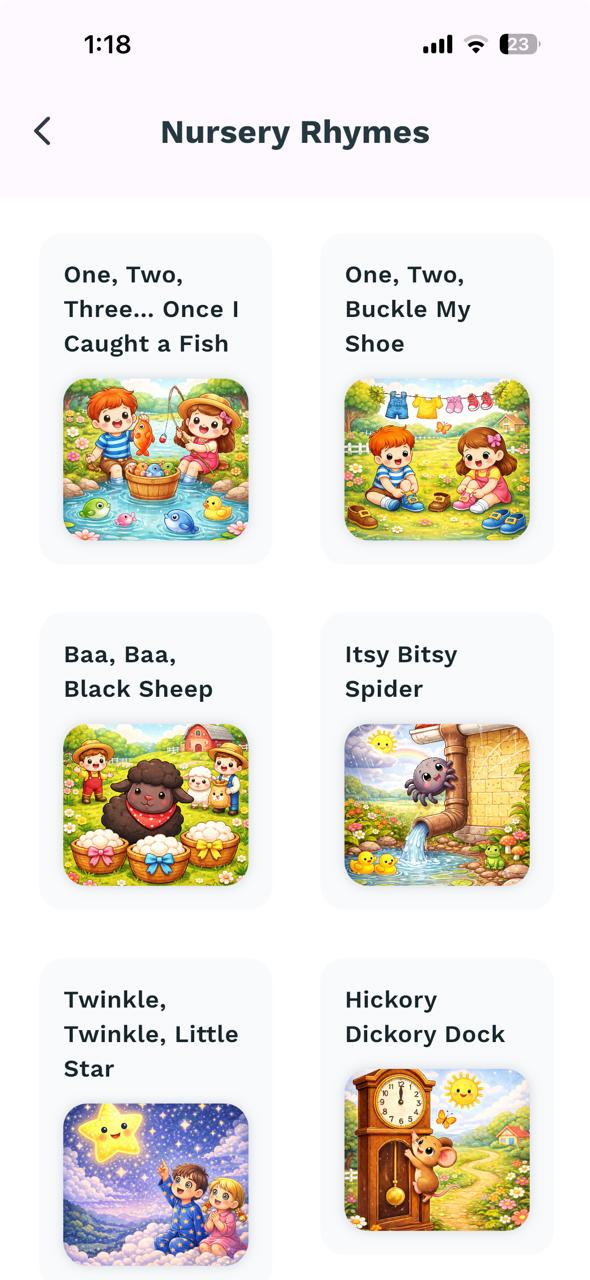
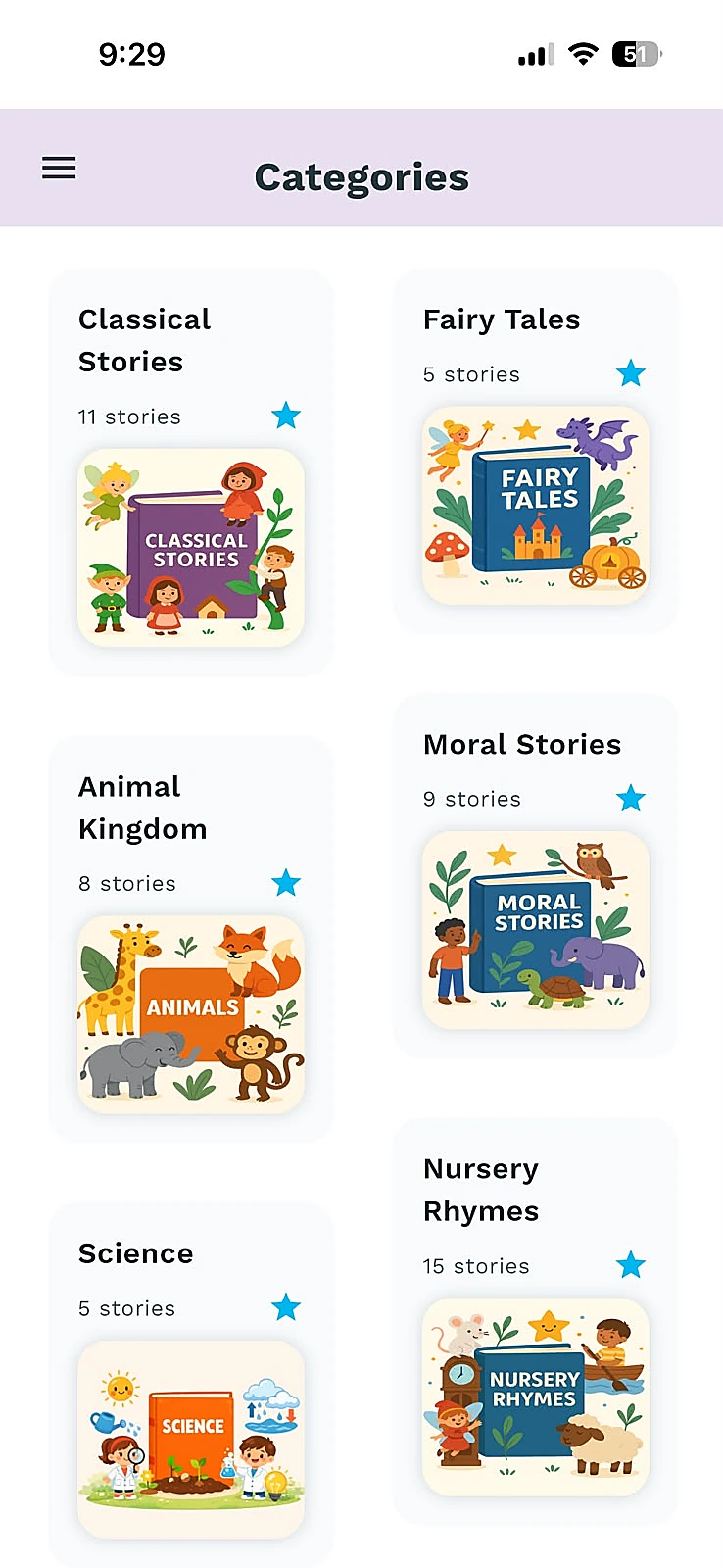
That is one of the reasons we wanted familiar nursery rhymes inside Baboo Stories. Instead of searching through videos whenever you forget a line, you can open the nursery-rhyme collection and find something familiar. Then you can read or sing it to your toddler yourself.
That distinction matters to us. Baboo Stories is designed around parent-led storytelling. The phone does not have to become the entertainer. It can simply give you the words.
Your toddler gets your voice.
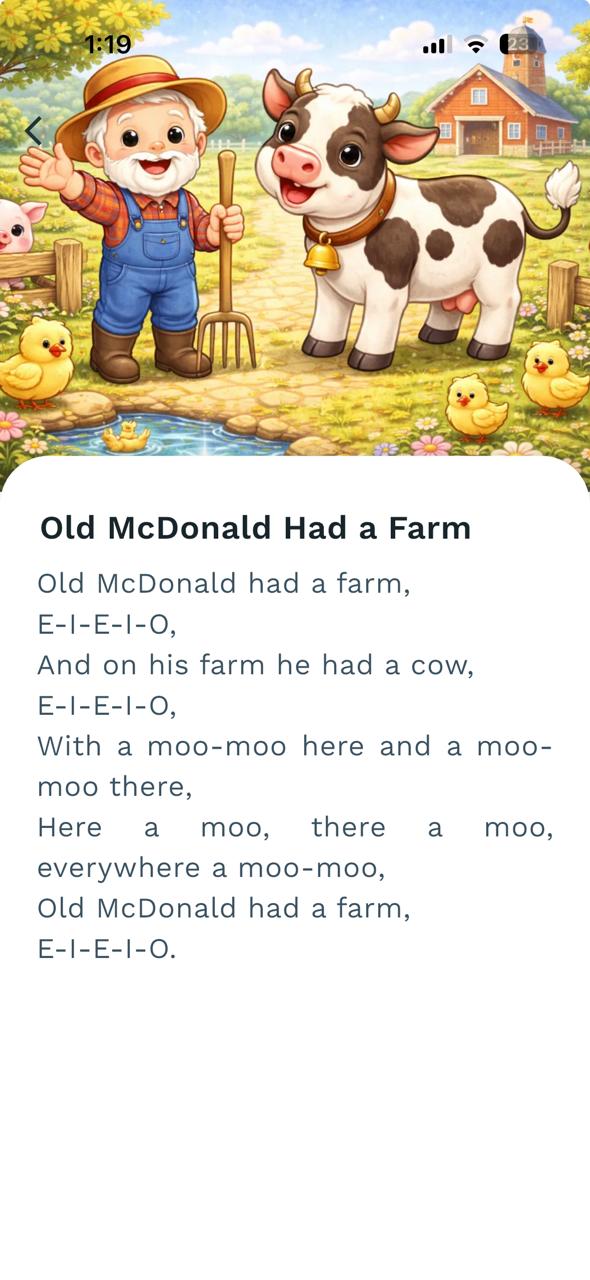
Nursery rhymes you may remember from childhood
Here are a few classics many parents grew up with:
- Twinkle, Twinkle, Little Star
- Humpty Dumpty
- Baa, Baa, Black Sheep
- Row, Row, Row Your Boat
- Hickory Dickory Dock
- Jack and Jill
- Mary Had a Little Lamb
- Itsy Bitsy Spider or Incy Wincy Spider
- Old MacDonald Had a Farm
- The Wheels on the Bus
- Five Little Ducks
- Hey Diddle Diddle
- Little Miss Muffet
- One, Two, Buckle My Shoe
- Rain, Rain, Go Away
Try one tonight. You may be surprised how quickly the tune comes back.
You do not need a good singing voice
Some parents avoid singing because they think, "I cannot sing." Your toddler is unlikely to care.
Sing badly. Change the tune. Forget a word. Invent one. Speak the rhyme dramatically instead. Whisper it. Make your teddy bear sing it.
The goal is not musical performance. The goal is interaction. Sometimes the imperfect version becomes the version your family loves most.
Try the finish-the-rhyme game
Once your toddler knows a rhyme, stop just before a familiar word.
For example: "Humpty Dumpty sat on a..." Pause. Let your toddler try to finish it.
Or: "Row, row, row your..." Pause again.
Do not worry if they cannot answer. Say the word together and continue. The game should feel playful, not like a test.
Turn nursery rhymes into conversations
A nursery rhyme can also become a starting point for talking.
- After "Twinkle, Twinkle, Little Star," ask: "Can we find a star tonight?"
- After "Baa, Baa, Black Sheep," ask: "What sound does a sheep make?"
- After "Itsy Bitsy Spider," ask: "Where do spiders live?"
- After "Row, Row, Row Your Boat," ask: "Where should our boat go?"
Perhaps your toddler says, "The moon." Excellent. Your boat is going to the moon. There is no correct destination.
Make familiar rhymes your own
You are allowed to change nursery rhymes. Put your toddler's name into one. Replace a character with their favourite animal. Invent another verse. Make the family dog part of the story. Use toys to act everything out.
That turns something familiar into imaginative play. And sometimes toddlers find the completely wrong version far funnier than the original.
Nursery rhymes vs stories: do you need both?
You do not really have to choose.
Nursery rhymes and stories serve slightly different purposes, and they work beautifully together. A rhyme can take thirty seconds. A short story might take five minutes.
One evening your toddler may sit through several stories. The next evening: "NO STORY!" Fine. Try a rhyme instead.
What matters is continuing to create small opportunities for language, imagination, and connection.
A simple 5-minute nursery rhyme routine
If you are wondering how to actually use nursery rhymes at home, try this.
Swipe or scroll horizontally to compare all columns.
| Minute | What to do |
|---|---|
| 1 | Let your toddler choose: "Twinkle Twinkle or Humpty Dumpty?" |
| 2 | Sing the rhyme together. Do not worry about singing perfectly. |
| 3 | Sing it again with actions. Clap, rock, point, or use your hands. |
| 4 | Pause before the rhyming words and give your toddler a chance to fill them in. |
| 5 | Ask one playful question: "What do you think happened next?" |
That is it. Five minutes. No preparation required.
Want words and actions ready to use? Try our 15 nursery rhymes for 2-year-olds.
Frequently asked questions about nursery rhymes
What age should I start nursery rhymes?
You can sing and speak rhythmically with children from infancy. As children become toddlers, they may increasingly participate with movements, sounds, and eventually words.
Are nursery rhymes good for language development?
They can support language-rich interaction through repetition, rhyme, vocabulary, and predictable sound patterns. Research has also found associations between nursery-rhyme knowledge and phonological sensitivity.
Do I have to sing nursery rhymes?
No. You can speak them rhythmically, whisper them, act them out, or simply read them.
Why does my toddler want the same rhyme repeatedly?
Repetition gives young children familiarity and opportunities to predict and participate. If they love the same rhyme tonight, there is nothing wrong with doing it again tomorrow.
Are nursery rhymes suitable before bedtime?
Gentler nursery rhymes can fit nicely into a calming evening routine. Save louder action rhymes for earlier if they make your toddler more energetic.
What if I have forgotten the words?
That is exactly why keeping a nursery-rhyme collection nearby can be useful. Baboo Stories includes familiar nursery rhymes so parents can quickly find one and read or sing it with their toddler.
Rediscover the nursery rhymes you grew up with
There may be dozens of songs hiding somewhere in your childhood memories. You may not remember every verse. That is okay.
We can help with the words. Baboo Stories brings familiar nursery rhymes together with gentle stories and calming reads for toddlers, giving parents something ready whenever their child asks: "One more?"
The app brings the rhyme. You bring the voice, cuddles, and silly actions.
Related Baboo guides
- How to build your child's vocabulary through stories and play
- Is it okay to repeat stories?
- How to read aloud to toddlers
- Benefits of story time
- Bedtime routine for toddlers
Sources and further reading
- Bryant, Bradley, Maclean, and Crossland: Nursery rhymes, phonological skills and reading
- National Literacy Trust Words for Life: Songs and rhymes
- National Literacy Trust: Early years resources and tools
- Illinois Early Learning Project: Using predictable books with young children
Install Baboo Stories
Baboo Stories is available now for iPhone and Android, for parents who want reading, rhymes, and storytelling to become a natural part of everyday family life. Download the app or get free story updates to hear about new stories and nursery-rhyme additions.


For stories you can read in your own voice, explore Baboo Stories. The app is free to download; an optional monthly subscription unlocks all stories.